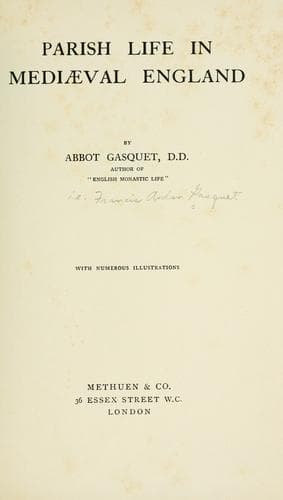
Parish life in mediæval EnglandGasquet, Francis Aidan
History
Parish life in mediæval England
Gasquet, Francis Aidan
England -- Church history -- 1066-1485; England -- Social life and customs -- 1066-1485
“Let all the Ministers of the Church,” says Bishop Quevil, in 1287,
“be diligent and careful in saying the Divine Office. In the name of
the Holy Trinity we order every minister of the church, carefully,
devoutly, clearly, and entirely, without any cutting down, to sing
or say the night and day Divine Office appointed by General Council.
Let those who chant it remember to pause in the middle of the verse,
and let no one begin any verse before the other has finished the
verse preceding;” and, in regard specially to parish churches, the
same Constitution ordered that “parish priests shall not leave their
churches until on feast days and Holy days they shall have said the
canonical hours either before or after Mass: and that no priest say
his Mass before he has done his duty to his Creator by saying Matins
and Prime.”
In the same way, in 1364, the Synod of Ely, held by Bishop Simon
Langham, ordered that priests were to say the whole office in their
churches, and
“that all pastors of souls and parish priests, when they had finished
the recitation of their Office in their churches, shall apply
themselves diligently to prayer and the reading of Holy Scripture, in
order that, by a knowledge of the Scriptures, they may be ready, as
becomes their office, to satisfy any one who asks for the reason of
their faith and hope. Let them ever be earnest in the teaching and
the effect of Scripture on their work, like the poles in the rings of
the ark of the covenant, so that their prayer may be nourished and
rendered fruitful by assiduous reading as by their daily bread.”
In some of the larger parish churches a considerable portion of the
Divine Office, as well as the Mass, was sung daily. A note in the
churchwardens’ accounts of St. Michael’s, Cornhill, London, written in
1538, asks prayers for “Richard Atfield, sometime parson of the church
... for that he, with consent of the bishop, ordained and established
Mattins, High Mass, and Evensong to be sung daily, in the year 1375.”
This had been done regularly for 163 years, and the hours at which the
various services were held would appear to have been: Matins at 7
a.m., High Mass at 9, and Evensong on work-days at 2 p.m.
Public-domain text, read in full here on John Shaqi.
Reviews
Reviews
No reviews yet
Be the first to share your thoughts on this work.
Elsewhere in the archive
Join the Discussion
Join the discussion
Sign in to leave a comment or review.
Sign InorCreate an account