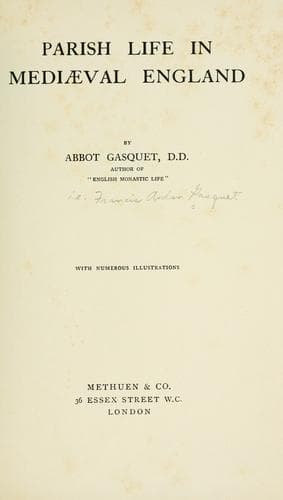
Parish life in mediæval EnglandGasquet, Francis Aidan
History
Parish life in mediæval England
Gasquet, Francis Aidan
England -- Church history -- 1066-1485; England -- Social life and customs -- 1066-1485
In many of the larger churches, also, benefactors or fraternities had
arranged for the singing of a _Salve_ or other anthem of Our Lady in
the evening time at her altar or statue. At these times also tapers
would usually be lit in honour of Christ’s holy Mother. In the church
of St. Mary-at-Hill, for example, in 1353, the practice existed, for
in that year a parishioner left money to support a priest, and among
his duties it is said “that he be every day in the same chirch after
evensong, at the time of syngyng of _Salve Regina_, and that he sing
the same, or else help the syngers after his cunnyng, in honour of
our blessed lady the Virgin.” At other places, as at St. Edmund’s,
Salisbury, for instance, the singing of the _Salve_ was only undertaken
at stated times. In this case the Fridays in Lent were apparently
chosen for this evening hymn to Our Lady.
Chaucer, in _The Prioress’s Tale_, makes a little boy, who doubtless
had taken his part in this, ask his older schoolfellow what another
such anthem of Our Blessed Lady meant--the _Alma Redemptoris_.
“Noght wiste he what this Latin was to seye,
For he so yong and tendre was of age;
But on a day his felow gon he preye
T’ expounden him this song in his longage,
Or telle him why this song was in usage.
* * * * *
“His felow, which that elder was then he,
Answerede him thus: ‘This song, I have herd seye
Was maked of our blisful Lady free,
Hir to salue, and eek hir for to preye
To been our help and socour when we deye.’
* * * * *
“‘And is this song maked in reverence
Of Christe’s moder?’ seyde this innocent:
‘Now, certes, I wol do my diligence
To conne it all eer Christemasse is went.’”
_Sunday in the Parish Church._--It is time to pass to the consideration
of what took place in the mediæval parish church on the ordinary
Sundays of the year. In the _Prymer_ of 1538 are to be found some
verses called _The Dayes of the Weke Moralysed_, in which the duty of
the Christian in regard to Sunday is thus set forth:--
“I am Sonday ye honourable,
The hede of all the weke dayes.
That day all thyng labourable
Ought to rest and gyve lawd and prayers
To our Creatour, that alwayes
Wuolde have us rest after travayle
Man-servant and thy beeste he sayes
And the other or thyn avayle.”
The first question that arises is as to the attendance of the people at
the Matins which preceded the parochial Mass. It would seem to be quite
certain that even in the smallest churches on Sundays and Holy days the
Office was recited by the priests, or, in the cases where there was
only one, by the priest and his clerk in the early morning. Further,
from the various directions and instructions given to the people, it
seems practically certain that they were not only expected to be at the
Matins, but, as far as possible, were actually present at them.
Public-domain text, read in full here on John Shaqi.
Reviews
Reviews
No reviews yet
Be the first to share your thoughts on this work.
Elsewhere in the archive
Join the Discussion
Join the discussion
Sign in to leave a comment or review.
Sign InorCreate an account