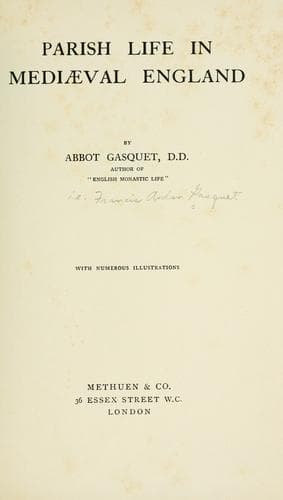
Parish life in mediæval EnglandGasquet, Francis Aidan
History
Parish life in mediæval England
Gasquet, Francis Aidan
England -- Church history -- 1066-1485; England -- Social life and customs -- 1066-1485
On the Sunday, moreover, after the blessing was finished, the priest
and his assistants came to the foot of the altar, which was sprinkled
with newly blessed water. Then turning, he, in the same way, sprinkled
each of the assistants as they passed before him, and, last of all, if
there were no procession, he passed down the church casting the water
upon each altar he came to, and upon the people gathered in the nave.
If there was a procession, as seems generally to have been the case,
the assistants and clerks, with the servers, followed the celebrant
singing the anthems proper for the day. The parish processional cross
was carried first, with two servers bearing candles, and with the
thurifer and the clerk “water-bearer.” In the smaller churches, when
the weather permitted, no doubt the procession would wend its way
outside, and pass along, followed by the people, amidst the graves of
those former parishioners who had gone before, and who were taking
their long rest in God’s acre. It was during this Sunday visit, in all
probability, that the living offered their prayers for their dead, and
cast the blessed water upon their graves. Some of the wills of the
fifteenth century show how this practice was prized. In one will, for
instance, a citizen of York leaves a bequest to three priests to say
Masses for his soul, and asks that “each after his Mass should proceed
to his grave, say a _De profundis_ over it, and sprinkle it with holy
water.” Another citizen of the same city, and a merchant, provided for
a priest to visit his grave daily and to cast the blessed water upon it.
To return to the procession. On coming back to the church, or, if there
had been no procession, when the sprinkling of the church had been
finished, the clergy and assistants in cathedrals, gathered round the
celebrant in front of the great rood at the entrance of the choir for
the _bidding prayer_. This was, in smaller parochial churches, however,
given out from the pulpit after the Gospel of the Mass, and will be
spoken of in connection with the Sunday sermon, to which a special
chapter must be devoted.
It is unnecessary to follow the Sunday congregation of a
pre-Reformation church through the singing of the parochial Mass.
The church itself, as the bequests in the wills of the fifteenth
century and other documents show, will have been gay with a profusion
of candles burning on the rood beam, on the altars, and before each
picture or shrine or image, whilst in many places the great “rowell,”
or candle-wheel, would have been lit up, and with its crown of candles
have added to the general appearance of festivity, which the people of
mediæval England loved so much to see in their churches.
Public-domain text, read in full here on John Shaqi.
Reviews
Reviews
No reviews yet
Be the first to share your thoughts on this work.
Elsewhere in the archive
Join the Discussion
Join the discussion
Sign in to leave a comment or review.
Sign InorCreate an account