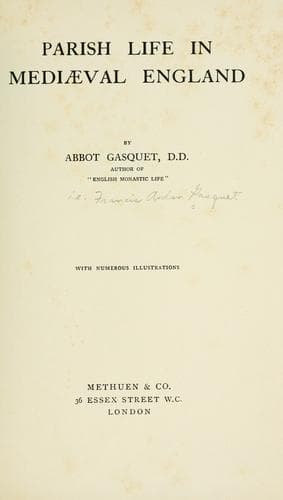
Parish life in mediæval EnglandGasquet, Francis Aidan
History
Parish life in mediæval England
Gasquet, Francis Aidan
England -- Church history -- 1066-1485; England -- Social life and customs -- 1066-1485
At the end of the Mass a loaf of bread, called the “holy loaf,” or
“holy bread,” was brought into the chancel, and, after being blessed by
the priest, was cut into small pieces and distributed to the people.
Then all came up to the chancel steps and received the morsel from the
celebrant, whose hands they kissed. This blessed bread signified the
fraternal love that always ought to bind Christians together, and the
practice of distributing it at the principal Sunday Mass continued
until the religious changes in the reign of Edward IV. That the custom
should be restored to them was one of the demands of the Devonshire
insurgents in that reign. The churchwardens’ accounts contain many
references to this pious practice: the purchase of baskets for the
distribution of the bread, for instance, is recorded at St. Michael’s,
Cornhill, St. Mary the Great, Cambridge, at Cratfield, and elsewhere.
At Bromley, in Surrey, the churchwardens collected from the people the
money to furnish the bread. In 1523, for instance, they acknowledge
a collection of 2_s._ for this purpose, and double that amount the
following year. Evidently, however, the custom which still prevails in
France, of families taking it in turn to give the bread to be blessed,
was not unknown in England in pre-Reformation days. Dr. Rock quotes
from some churchwardens’ accounts of Stamford-in-the-Vale, Berks, to
show that the custom was revived in Queen Mary’s days. A piece of land
there, “called Gander’s,” provided at least a portion of the expense.
“The whole value of the chargis,” says the document, “comyth to
2½_d._ and it is thus divided. They offer to the curatis hand too
penyworth of bread with halfepeny candull--brought uppe to the preste
at the highe altar. Of the too penyworthe of breade they reserve
a halfepenny lofe whole for to be delyvered to the next that shul
geve the holy lofe, for a knowledge to prepare against the Sonneday
followyng.”
The remainder of the Sunday, with the exception of the time--from half
an hour to three-quarters--spent in taking part in the Evensong or
Vespers, which were probably sung about two or three o’clock in the
afternoon, was devoted to rest and reasonable recreation, about which
something will be said in a subsequent chapter. For the priest Sunday
was the day when by law he had to visit the aged, infirm, and sick in
his parish. “Let the priests,” says the Constitution of Gilbert, Bishop
of Chichester, in 1289, “see the sick every Sunday and feast day, and
let them visit them with diligence. Let them take heed that they make
no difficulty about attending to the sick at whatever hour they may be
asked for.” This same order is repeated in the Constitutions for the
Province of York in 1518, more than two centuries after.
Public-domain text, read in full here on John Shaqi.
Reviews
Reviews
No reviews yet
Be the first to share your thoughts on this work.
Elsewhere in the archive
Join the Discussion
Join the discussion
Sign in to leave a comment or review.
Sign InorCreate an account