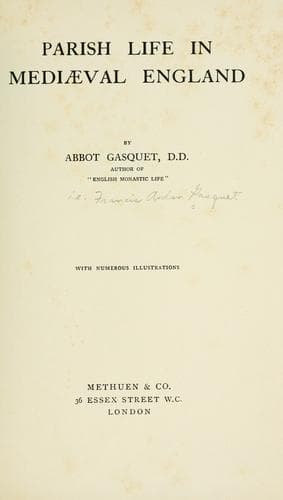
Parish life in mediæval EnglandGasquet, Francis Aidan
History
Parish life in mediæval England
Gasquet, Francis Aidan
England -- Church history -- 1066-1485; England -- Social life and customs -- 1066-1485
“Every deadly sin is servile work, and such servile work God defendeth
every day, but most on the Holy day. For he that doth deadly sin
on the Holy day he doth double sin, for he doth sin and thereto he
breaketh the Holy day against God’s precept. Also servile work is
called every bodily work done principally for lucre and worldly
winning, as buying, selling, sowing, mowing, reaping, and all craft
of worldly winning, also markets, fairs, sitting of Justices and of
Judges, shedding of blood and execution, of punishing by law, and
all works that should draw men from God’s service. Nevertheless, if
sowing, reaping, mowing, carting, and such other needful works (are
done) purely for alms, and only for heaven made, and for need of them
that they are done to on holy days, then are they not servile works
nor the holy day broken thereby. Nevertheless, on Sundays and great
feasts, such works should not be done, but if great need compel men
thereto and deeds of great charity.”
Then, after saying that certain tradesmen and merchants are permitted
the preparation of wares and foods that must be ready on the Monday,
the author of _Dives and Pauper_ proceeds: “Also messengers, pilgrims,
and wayfarers that might well rest without great harm are excused, so
that they do their duty to hear Matins and Mass, if they mown, for long
abyding in many journeys is costful and perilous.” Any tendency to grow
slack in the observance of the Sunday was noted, and strictly repressed
by the authorities. In one instance a bishop directs the priest to
put a stop to the shoemakers in his parish working on the Lord’s day,
as he has heard they did; in another an inquiry is ordered upon a
denunciation being made against an individual; and in a third a parson
is directed to denounce a parishioner from the pulpit for having been
proved to have worked without reason on a holy day.
Public-domain text, read in full here on John Shaqi.
Reviews
Reviews
No reviews yet
Be the first to share your thoughts on this work.
Elsewhere in the archive
Join the Discussion
Join the discussion
Sign in to leave a comment or review.
Sign InorCreate an account