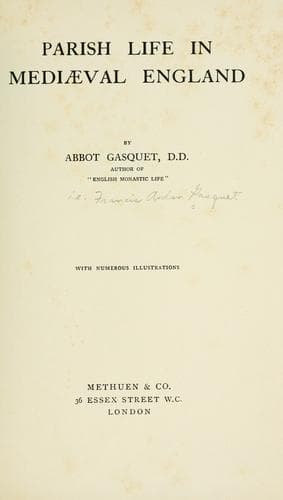
Parish life in mediæval EnglandGasquet, Francis Aidan
History
Parish life in mediæval England
Gasquet, Francis Aidan
England -- Church history -- 1066-1485; England -- Social life and customs -- 1066-1485
From the earliest times work was prohibited on Sundays and holy days.
Lyndwood, in his gloss on the Constitution of Archbishop Chicheley
prohibiting on such days “all servile work in any city or place of the
Province of Canterbury,” explains at some length the nature of the
prohibition. When the work was genuinely necessary, as might be in
the case of a barber, or a blacksmith, or a cook, then it was excused
by the necessity, and did not come under the law. But where the work
could be done on another day, or could have been easily anticipated
or postponed, then it was prohibited by ecclesiastical law. This
applied to the fairs and markets, which were so often held on feast
days, and which the authorities in the fourteenth century were so much
concerned to suppress, and the prohibition affected as well those who
sold as those who bought at them. The Constitution of John Thoresby,
Archbishop of York in 1367, was the first order against the growing
practice of holding markets and fairs on the Sundays, and the misuse
of the cemeteries in this respect. The following year Archbishop Simon
Langham sent out a general monition for the Province of Canterbury, and
a special prohibition against certain abuses in the Isle of Sheppey,
where, “for the noise of the people, the solemnities of the Mass in
the church” were disturbed, and where, on account of the attraction of
the market, people were induced to neglect their duty of being present
at the Divine Service. The prohibition against selling and purchasing,
however, did not apply to the ordinary necessaries of life, as bread,
meat, etc., so long as the sale or purchase did not interfere with the
religious obligations of the parties, and did not prevent them from
going to church.
In another place the same canonist states, as he says, “briefly,” what
kind of work was to be considered “servile,” and as such was prohibited
to the people in mediæval England. This includes all mechanical,
agricultural, and mercantile work, as well as the holding of courts or
legal inquiries of every kind, unless “reasonable necessity or charity”
required that any such work should be undertaken. In the cause of
charity, however, it was held to be lawful on the holy days to assist
to till, etc., the lands of the really poor, after all religious duties
had been fulfilled. The obligation of resting from servile work on the
Sunday or festival was reckoned from the Vesper hour on the Saturday,
or the eve.
The instruction given to the people as to servile work was very clear
and well understood. In _Dives and Pauper_ it is thus put:--
Public-domain text, read in full here on John Shaqi.
Reviews
Reviews
No reviews yet
Be the first to share your thoughts on this work.
Elsewhere in the archive
Join the Discussion
Join the discussion
Sign in to leave a comment or review.
Sign InorCreate an account