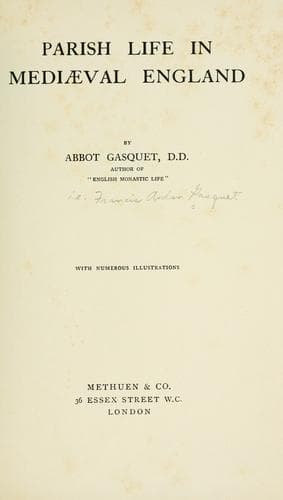
Parish life in mediæval EnglandGasquet, Francis Aidan
History
Parish life in mediæval England
Gasquet, Francis Aidan
England -- Church history -- 1066-1485; England -- Social life and customs -- 1066-1485
The sphere of work of the local clergy was the parish, which was
by no means the same as the town, hamlet, or manor. According to
an authority, in the thirteenth century the distinction was fully
recognised. “For in one town there may be several parishes,” he says,
“and in one parish several manors, and several hamlets may belong
to one manor.” The parochial system, then, in the Middle Ages, had
come to occupy three separate _functions_. It had acquired, in the
first place, the notion of a well-defined group of families organised
for the purposes of social order and the relief of needy brethren.
Secondly, the word “parish,” applied to the same group, was regarded as
a sub-unit of ecclesiastical administration, directly under the parish
priest, indirectly under the bishop. Thirdly, it was the name of the
foundation property or estate.
From the earliest times in the Christian Church the duty of all to
assist according to their means in the support of their poorer brethren
was fully recognised. The peculiar method, however, of enforcing this
duty by the regular payment of tithes was apparently insisted on in the
West by the second Council of Macon in A.D. 585, and in the Council of
Rouen in A.D. 650. In England, to speak only of it, by the middle of
the tenth century the religious duty of paying tithe was enforceable
at law, and this tax was commonly called “God’s portion,” “God’s
consecrated property,” “the Lord’s Bread,” “the patrimony of Christ,”
“the tribute of needy souls.” This was undoubtedly the view taken in
pre-Reformation days of the duty of all to pay the tenth portion of
their goods for the use of the Church. What that use was has frequently
been entirely misrepresented and misunderstood. In the words of the
author of the tract on the _Rise of the Parochial System in England_--
“it must be always remembered that in the view of the Church, tithes
other than first fruits, and tithes of increase, were destined not to
provide a maintenance for the clergy, but for the relief and support
of the poor; and the rector, whether of a religious house or parochial
incumbent, was supposed to administer them for these purposes, he
being only a ruler or administrator of them.... During the whole of
the time that the English Church was ruled as an integral part of the
Western Patriarchate, this view of the destination of tithes, and of
the rector’s or administrator’s duty in respect of them, was never
lost sight of.”
Public-domain text, read in full here on John Shaqi.
Reviews
Reviews
No reviews yet
Be the first to share your thoughts on this work.
Join the Discussion
Join the discussion
Sign in to leave a comment or review.
Sign InorCreate an account