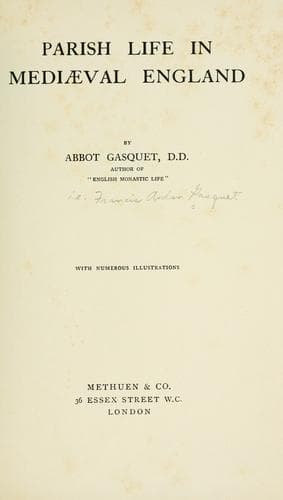
Parish life in mediæval EnglandGasquet, Francis Aidan
History
Parish life in mediæval England
Gasquet, Francis Aidan
England -- Church history -- 1066-1485; England -- Social life and customs -- 1066-1485
On the feast of Holy Innocents the boy-bishop was frequently expected
to preach a sermon, which had been written for him. One such, written
for a boy in St. Paul’s school by Erasmus, is still extant. Until
Archbishop Peckham’s day the “little Nicholas and his clerks” used
to take a conspicuous place in the services of the church during
the octave of the feast, but in 1279 that prelate decreed that the
celebration should be confined to the one day of the feast only. That
this feast was popular, and that our forefathers delighted in coming
to their parish churches to witness their children associated in this
ceremonial around God’s altar, may be judged from the statute of Roger
de Mortival, Bishop of Sarum in 1319, in which he forbids too much
treating of the children, and orders that the crowd at the procession
are not to hustle or hinder the boys as they do their ceremonies.
Hardly had the festivals connected with Christmas been celebrated,
than on the second day of February the _Feast of the Purification_,
known as _Candlemas Day_, was kept. From the earliest times our English
forefathers gathered together in their parish churches on that day,
for the blessing of the candles and for the procession with lighted
tapers, as the symbols of the burning love of their hearts for Christ,
and in memory of the presentation of our Blessed Lord in the Temple.
Ælfric, the Saxon homilist, speaks of the feast in his days, and the
celebration remained the same till the change of religion.
“Be it known also to every one,” he says, “that it is appointed in the
ecclesiastical observances, that we on this day bear our lights to
church and let them there be blessed: and that we should go afterwards
with the light among God’s houses and sing the hymn that is thereto
appointed. Though some men cannot sing, they can, nevertheless, bear
the light in their hands; for on this day was Christ the true light
borne to the temple, Who redeemed us from darkness, and bringeth us to
the Eternal Light, who liveth and ruleth for ever.”
ASH WEDNESDAY.--The great fast of Lent, which was a time devoted to
penance for sins, and in which sorrow for offences was increased by
the continual memory of Christ’s suffering and death for mankind, was
ushered in by what was known as _Shrove-tide_. This was the week that
followed _Quinquagesima_ Sunday, the Sunday before Ash Wednesday.
As its name imports, it was the time when Christians were urged to
prepare their souls for the weeks of Lenten penance by confessing
their sins to God through their parish priest, or, as they said,
shriving themselves. “Now is a clean and holy tide drawing nigh,” said
a homilist, “in which we should make amends for our heedlessness; let,
therefore, every Christian man come unto his confessor, and confess his
secret guilt.”
[Illustration: THE SACRAMENT OF PENANCE]
Public-domain text, read in full here on John Shaqi.
Reviews
Reviews
No reviews yet
Be the first to share your thoughts on this work.
Elsewhere in the archive
Join the Discussion
Join the discussion
Sign in to leave a comment or review.
Sign InorCreate an account