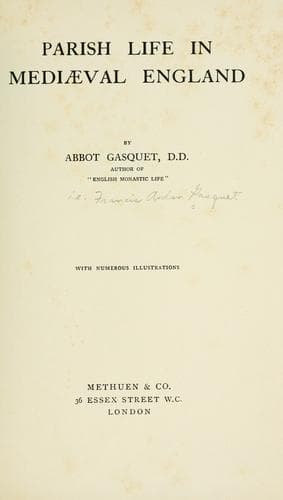
Parish life in mediæval EnglandGasquet, Francis Aidan
History
Parish life in mediæval England
Gasquet, Francis Aidan
England -- Church history -- 1066-1485; England -- Social life and customs -- 1066-1485
On _Ash Wednesday_ in each parish church, before the celebration of
Mass, ashes were blessed, and each man, woman, and child came and knelt
before their priest to have them strewn upon their heads, whilst his
words reminded them that they “were dust, and unto dust they would
return.” After the distribution of the ashes, according to an ancient
English custom, if there were another church in the same district, all
the people went to it in procession, and, having made there “a stay,”
or _statio_, for prayer, returned to their own church for Mass. With
Ash Wednesday began the strict fast of Lent, which had to be kept on
all days except Sundays; and even then no meat was permitted. On the
week-days the fast was not allowed to be broken till after Mass and
Vespers had been said in the parish church; that is, before eleven or
twelve o’clock. The Anglo-Saxon _Ecclesiastical Institutes_ speaks of
those days of Lent as “the tithing-days of the year,” which all good
Christians should render to God most strictly. “Every Sunday at this
holy tide,” says the same authority, “people should go to housel,” a
practice which was not preserved in the later middle ages. The time of
Lent was also known as the “holy time,” and unnecessary and distracting
business was as far as possible avoided. Thus, for instance, the
assizes were prohibited during the whole period.
THE LENTEN CURTAIN.--From the evening before the first Sunday of
Lent till the Thursday before Easter, what was known as the “Lenten
curtain,” or “Lenten veil,” hung down in all parish churches between
the chancel and the nave. It was one of the “ornaments” which the
parishioners were bound to provide, and the churchwardens’ accounts
contain many references to it, both as to its provision and as to the
expenses of erection. It was made of white stuff or linen, and hid
the sanctuary from the people, except at the reading of the Gospel
and until the _Orate Fratres_, when it was pulled aside. It was also
drawn back on all feast days kept during Lent. The order that the
confessions of women should be heard “outside the veil,” in the sight
of all but out of hearing, refers to the Lenten veil. “The veil,” says
the _Liber Festivalis_, “that all the Lent has been drawn between the
altar and the choir betokeneth the prophecy of Christ’s Passion, which
was hidden and unknown till these days.” But in these three last days
of Holy Week it “is done away (with), and the altar openly schowed to
all men; for on these days Christ suffered openly His Passion.”
Public-domain text, read in full here on John Shaqi.
Reviews
Reviews
No reviews yet
Be the first to share your thoughts on this work.
Elsewhere in the archive
Join the Discussion
Join the discussion
Sign in to leave a comment or review.
Sign InorCreate an account