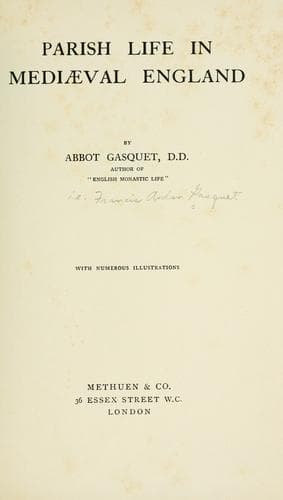
Parish life in mediæval EnglandGasquet, Francis Aidan
History
Parish life in mediæval England
Gasquet, Francis Aidan
England -- Church history -- 1066-1485; England -- Social life and customs -- 1066-1485
This account of parochial life in pre-Reformation England requires
some brief description of the Sacramental system, which had its
effect on every soul in the district. From the time of his baptism as
a child of the Church, till his body was laid to rest in its tomb,
each parishioner was the constant recipient of some one of those
mysterious rites, by which, as he was taught by the Church and as he
believed, God’s grace was received into his soul to enable him to
lead the life of a good Christian. In the administration of these
Sacraments, nothing is more clear in the teaching of the Church of the
Middle Ages than that there was to be no question of money. They--the
Sacraments--were spiritual things, and to sell them for fees would be
plain simony, which was prohibited by every law of God and man. If
the administrator was permitted to take an offering, it was only with
the plain understanding that the payment was made in regard to the
service rendered, for which the recipient desired to make some return;
and that the Sacrament should be given without the fee. In the case
of such a Sacrament as Penance, for example, where the acceptance of
a fee or offering might lead to a misunderstanding of the judicial
character of the rite, and so bring it into contempt, the reception
of money was altogether prohibited by the ecclesiastical authorities,
and any such abuse was sternly repressed. Thus, to take an example,
in the acts of the Synod of Ely in 1364, the bishop, Simon Langham,
says, “We have heard, and greatly grieve to have done so, that some
priests exact money from the laity for the administration of penance or
other Sacraments, and that some, for the sake of filthy lucre, impose
penances” which bring in money to them. “These we altogether prohibit.”
The Sacraments, according to the teaching of the Church, which every
one who pretended to be a practical Christian was bound to receive,
were Baptism, Confirmation, Penance, Holy Eucharist, Extreme Unction,
and in the case of those desiring to marry, Matrimony. Something may,
therefore, usefully be said about each of these.
Public-domain text, read in full here on John Shaqi.
Reviews
Reviews
No reviews yet
Be the first to share your thoughts on this work.
Elsewhere in the archive
Join the Discussion
Join the discussion
Sign in to leave a comment or review.
Sign InorCreate an account