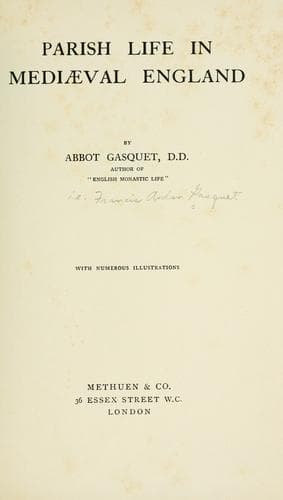
Parish life in mediæval EnglandGasquet, Francis Aidan
History
Parish life in mediæval England
Gasquet, Francis Aidan
England -- Church history -- 1066-1485; England -- Social life and customs -- 1066-1485
BAPTISM.--“To those coming into the _mare magnum_ of this world,” says
the legate Othobono, “Baptism must be regarded as the first plank of
safety in this sea of many shipwrecks to support us to the port of
salvation.” It is, he continues, the gate through which all have to
enter to enjoy the grace of the other Sacraments, and for this reason
“any error in regard to it is most dangerous,” and the possibility of
any child dying without receiving the saving waters is to be zealously
guarded against. Because of the priceless efficacy of the Sacrament,
every parish priest was warned to teach his people in the vernacular
the form of properly administering it, in case of need when a priest
could not be had. On this matter also the Archdeacon in the time of
his visitation of a parish was to inquire diligently whether these
instructions had been given, and whether the parishioners generally
knew how to baptize in case of need.
The importance which the Church attached to this Sacrament is well
illustrated by a Constitution of St. Edmund of Canterbury, which orders
that when the expectation of childbirth becomes imminent, all parents
should be warned to prepare a vessel and water to be ready at hand, in
case some sudden need should require the administration of baptism.
Ordinarily speaking, there can be no doubt that the old English
practice was that every child should, if possible, be baptized in the
parish church on the day of birth. In the ancient “proofs of age,”
this practice is evident; one example will be sufficient. In 1360 it
was requisite to prove the age of John, son and heir of Adam de Welle,
and the first witness who was called, said that “he knew that he was
born on the eve of St. Bartholomew the Apostle, because he was with his
master who stood god-parent to the child on that day, which was Sunday
21 years ago.” Another witness adds, that it was in the evening that
the baptism took place; and another that it was performed by John de
Scrubby, the chaplain.
There was, however, an exception. There were two days for public
baptism in the church, namely, Holy Saturday and the Saturday before
Pentecost, on which days the font in every parish church was solemnly
blessed. Apparently among English mothers in the thirteenth century,
this day was regarded as unlucky, and was avoided by them as far as
possible for the baptism of their children, a superstition that the
two legates Otho and Othobono endeavoured to eradicate. It became
consequently in England the practice, if children were born within
eight days of either of these two vigils of Easter or Pentecost, that
their baptism should be administered after the blessing of the font,
if there were no danger in the delay. In the case of the baptism being
held over, however, halfway between the day of birth and the day of
baptism, the child was to have all the accompanying rites administered
except only the actual baptism.
Public-domain text, read in full here on John Shaqi.
Reviews
Reviews
No reviews yet
Be the first to share your thoughts on this work.
Elsewhere in the archive
Join the Discussion
Join the discussion
Sign in to leave a comment or review.
Sign InorCreate an account