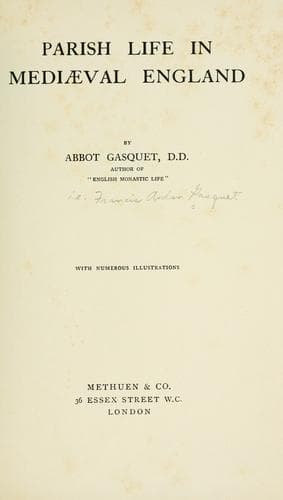
Parish life in mediæval EnglandGasquet, Francis Aidan
History
Parish life in mediæval England
Gasquet, Francis Aidan
England -- Church history -- 1066-1485; England -- Social life and customs -- 1066-1485
“The seventh Sacrament is wedlock,” it says, “before the which
Sacrament the banes in holy church shal be thryes asked on thre
solempne dayes--a werk day or two between, at the lest: eche day on
this maner: _N._ of V. has spoken with _N._ of P. to have hir to his
wife, and to ryght lyve in forme of holy chyrche. If any mon knowe any
lettyng qwy they may not come togedyr say now or never on payne of
cursyng.”
On the day appointed for the marriage, at the door of the church, the
priest shall interrogate the parties as follows:--
“_N._ Hast thu wille to have this wommon to thi wedded wif. _R._ Ye
syr. My thu wel fynde at thi best to love hur and hold ye to hur and
to no other to thi lives end. _R._ Ye syr. Then take her by yor hande
and say after me: I _N._ take the _N._ in forme of holy chyrche to
my wedded wyfe, forsakyng alle other, holdyng me hollych to the, in
sekenes and in hele, in ryches and in poverte, in well and in wo, tyl
deth us departe, and there to I plyght ye my trowthe.”
Then the woman repeated the form as above.
It was this “Marriage at the church door” which had to be established,
according to Bracton, in any question as to the legality or
non-legality of the contract. After this “taking to wife at the church
door,” the parties entered the church and completed the rite in the
church itself. As in the case of baptisms, churchings, and funerals,
the fee for marriages was fixed at 1_d._, but apparently all who could
afford it, gave more.
“Three ornaments,” says the author of _Dives and Pauper_--“three
ornaments (at marriage) belonged principally to the wyfe: a rynge on
her finger, a broche on hyr breste, and a garlande on hir head. The
rynge betokeneth true love; the broche betokeneth clenness of herte
and chastity that she ought to have; and the garland betokeneth the
gladness and the dignity of the sacrament of wedlock.”
Some of the ornaments for the bride at marriage the parish provided.
The nuptial veil was one of the things which the churchwardens were
supposed to find, and frequent inquiries were made concerning it in
the parochial visitations. In one parish the wardens possessed “one
standing mazer to serve for brides at their wedding;” and in another, a
set of jewels was left in trust for the use of brides on their wedding
day. If lent outside the parish, they were to be paid for, and the
receipt was to go to the common purposes of the church to which they
belonged.
CHAPTER X
THE PARISH PULPIT
Public-domain text, read in full here on John Shaqi.
Reviews
Reviews
No reviews yet
Be the first to share your thoughts on this work.
Elsewhere in the archive
Join the Discussion
Join the discussion
Sign in to leave a comment or review.
Sign InorCreate an account