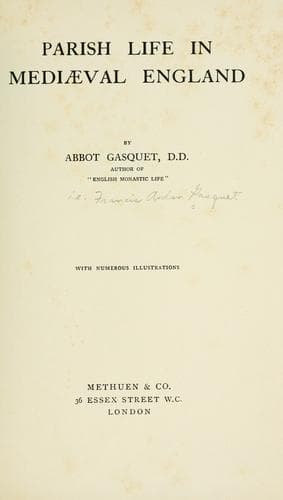
Parish life in mediæval EnglandGasquet, Francis Aidan
History
Parish life in mediæval England
Gasquet, Francis Aidan
England -- Church history -- 1066-1485; England -- Social life and customs -- 1066-1485
Then, it was in the church that all laws, civil as well as
ecclesiastical, were published. Here, too, notice of all manner of
civil proceedings was made. A, for instance, had died and been laid
to rest in the churchyard; it is from the pulpit of his parish church
that the fact is announced that he has left B and E the executors of
his will, and people are notified to send in their claims, or pay what
is owing to the estate to these two. Or it may be that A has died
intestate, or that those he has appointed to carry out his wishes will
not do so, in which cases people are to be warned that the bishop’s
official will administer the estate, and all claims are to be sent in
to him.
Then all questions of social order and well-being, as well as
infraction of law in the district, came before the people in some form
or other in the church and from the pulpit.
“When Agnes Paston,” for example, “built a wall (across a property to
which the people claimed access), it was thrown down before it was
half completed, and threats of heavy amercements (says Dr. Gairdner)
were addressed to her in church, and the men of Paston spoke of
showing their displeasure when they went in public procession on St.
Mark’s day.”
So, also, the parish priest of Standon, at the beginning of the
fifteenth century, was ordered to publish an excommunication under the
following circumstances: Margaret Basun, a parishioner, was charged
by some people with having stolen a silver ring belonging to Alice
Braymer, and with having sold it to Anne Boghley. Margaret Basun denied
the truth, and was called to make canonical purgation before the
bishop. She did so, and the bishop, having heard the case, declared her
innocent of the charge, and ordered her innocence to be proclaimed, and
an excommunication to be pronounced against those who had defamed her.
To take another sample case: a man spread false stories about the
apprentices of his father, saying that they had been the thieves of
some goods, etc., which had been stolen. An examination by the bishop
revealed the fact that it was the accuser who was in reality the
robber, and it was proved that he had made a false key, had opened his
father’s chest, and taken from it money and jewels. The bishop directed
that this should be told the people on the following Sunday.
Public-domain text, read in full here on John Shaqi.
Reviews
Reviews
No reviews yet
Be the first to share your thoughts on this work.
Elsewhere in the archive
Join the Discussion
Join the discussion
Sign in to leave a comment or review.
Sign InorCreate an account