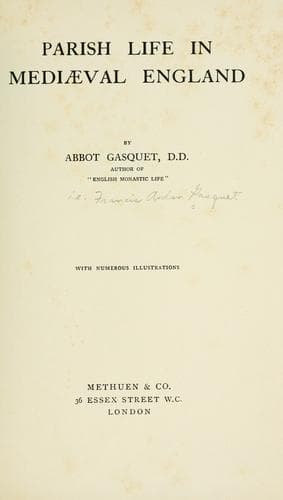
Parish life in mediæval EnglandGasquet, Francis Aidan
History
Parish life in mediæval England
Gasquet, Francis Aidan
England -- Church history -- 1066-1485; England -- Social life and customs -- 1066-1485
Once more: a person has been much defamed in his parish by people
saying he had buried a child in his back garden. He denied this
charge utterly, and the denial was published to the people from the
pulpit, whilst his accusers were warned to come before the bishop and
oppose his purgation. Or, lastly: John Spencer, the official of the
Archdeacon of Lincoln, issued a letter to be read in the parish church,
in which he declares that he has had before him Alice B. and Matilda
S. The former had defamed the latter by calling her a _meretrix_. On
examination this was found to be untrue, and Matilda S. was declared
innocent. Alice B. is to be compelled to cease these injuries, and to
pay all the expenses.
Another set of proclamations which had to be made on the Sunday from
the parish pulpit were the excommunications pronounced by the bishop
or by some other authority. In the Register of Bishop Bronescombe
is a document, dated November 24, 1277, pronouncing two people of
good family excommunicated for living together without being rightly
married. The fact is notorious, and “the keys of the Church are vilely
despised,” and this contempt may be hurtful to ecclesiastical authority
if allowed to continue. For this reason the bishop’s sentence of
excommunication is ordered to be published in every church and chapel.
A second instance may be taken from Bishop Grandisson’s Register for
1335. It appears that one John Hayward, the bailiff of Plympton Priory,
for some reason not apparent, took sanctuary in the church of Sutton.
Despising the sanctity of the place, some people unknown broke down the
doors of the church, and, dragging the unfortunate man from his place
of safety, wounded him, and even broke both his thighs. The bishop
consequently orders the sentence of greater excommunication to be
pronounced upon the unknown criminals, “with bell and candle,” in all
churches.
Other instances of excommunications published from the church
pulpit are: (1) For detaining “charters, rolls, indentures, bills,
evidences, and other muniments,” which had to do with the right of
a man’s succession to the estate of his father. The persons holding
the documents are unknown, and so all who have them, or are assisting
in concealing them, are excommunicated after fifteen days. (2) For
stealing a trap to catch eels, set in a pool called in English “a
leap,” and throwing it into a pool in the town of C, belonging to the
Prior of O. (3) For laying violent hands on a priest, who was known
to be one by his dress and tonsure. (4) For breaking into the room of
Thomas, rector of a London parish. The room was, by the way, in the
Campanile, and the thieves took clothes, gold, and silver to the value
of 40_s._, etc.
Public-domain text, read in full here on John Shaqi.
Reviews
Reviews
No reviews yet
Be the first to share your thoughts on this work.
Elsewhere in the archive
Join the Discussion
Join the discussion
Sign in to leave a comment or review.
Sign InorCreate an account