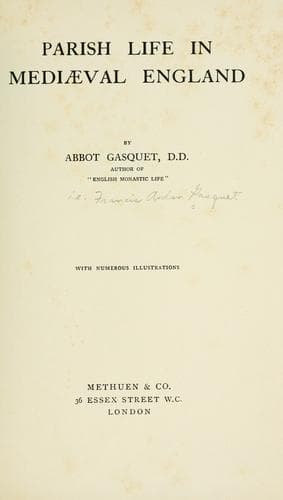
Parish life in mediæval EnglandGasquet, Francis Aidan
History
Parish life in mediæval England
Gasquet, Francis Aidan
England -- Church history -- 1066-1485; England -- Social life and customs -- 1066-1485
Every account of a mediæval parish must necessarily include some
description of the work of fraternities and guilds. Although these
societies, absolutely speaking, were not existent in every parish,
still they were so very general that they may be reckoned certainly as
one feature of pre-Reformation parochial life. It is hardly necessary
to say much upon the subject of guild origins. Their existence dates
from the earliest times, and they probably were one result of the
natural desire to realize some of the obvious benefits arising from
combination, in carrying out purposes of common utility. As a system of
widespread practical institutions, “English guilds,” says Mr. Toulmin
Smith, who may be regarded as our great authority on this matter,
“are older than any kings of England.” The oldest of our ancient
laws--those, for example, of Alfred, of Athelstan and Ina--assume the
existence of guilds, to some one of which, as a matter of course, every
one was supposed to belong. The same author thus defines the scope and
purpose of the ancient guilds. “They were,” he says, “associations of
those living in the same neighbourhood, who remembered that they had,
as neighbours, common obligations.” They were different entirely from
modern partnerships or trading companies, for their main characteristic
was to set up something higher than personal gain and mere materialism
as the main object of man’s existence, and to make the teaching of love
to one’s neighbour, not merely accepted as a hollow dogma of morality,
but known and felt as a habit of life.
An examination of the existing records leads to a general division of
mediæval guilds into two classes--_Craft_ or _Trade_ Associations and
_Religious_ Societies; or, as some prefer now to call them, _Social_
Guilds. It is with these latter that we are here chiefly concerned.
The former, as their name implies, had as the special object of their
existence the protection of some kind of work, trade, or handicraft;
and in this, for practical purposes, we may include those associations
of traders or merchants known under the name of “Guild-Merchants.”
Such, for instance, were the great Companies of the City of London;
and it was in reality the plea that they were trading societies, which
saved them from the general destruction which overtook all fraternities
and associations in the sixteenth century. The division of guilds
into the two classes named above is, however, after all, a matter of
convenience, rather than a real distinction, grounded on fact. All
guilds, no matter for what special purpose they were founded, had the
same general characteristic principle of brotherly love and social
charity; and no guild, so far as I have been able to discover, was
divorced from the ordinary religious observances commonly practised in
those days.
Public-domain text, read in full here on John Shaqi.
Reviews
Reviews
No reviews yet
Be the first to share your thoughts on this work.
Elsewhere in the archive
Join the Discussion
Join the discussion
Sign in to leave a comment or review.
Sign InorCreate an account