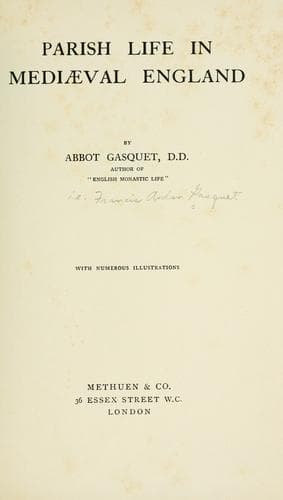
Parish life in mediæval EnglandGasquet, Francis Aidan
History
Parish life in mediæval England
Gasquet, Francis Aidan
England -- Church history -- 1066-1485; England -- Social life and customs -- 1066-1485
In speaking, therefore, of the purposes of what I have called
religious or social guilds, I must not be thought to exclude craft or
trade guilds. It is very often supposed that, for the most part, what
are called religious guilds existed for the purpose of promoting or
encouraging some religious practice, such as attendance at church on
certain days; taking part in ecclesiastical processions; the recitation
of offices and prayers, and the like. Without doubt there were such
societies existing in pre-Reformation days, such as, for example, was
the great Guild of Corpus Christi, in York, which counted its members
by thousands. But such associations were the exception, not the
rule. It is really astonishing to find how small a proportion these
_ecclesiastical_ or purely religious guilds formed of the whole number
of associations known as guilds. The origin of the mistaken notion is
obvious.
In mediæval days--that is, in the days when such guilds flourished--the
word “religious” had a wider, and in many ways a truer signification
than has obtained in later times. Religion was understood to include
the exercise of the two commandments of charity--the love of God, and
the love of one’s neighbour; and the exercises of practical charity,
to which guild brethren were bound by their guild statutes, were
considered as much religious practices as the attendance at church, or
the taking part in any ecclesiastical procession. In these days, as
Mr. Brentano, in his essay _On the History and Development of Gilds_,
has pointed out, most of the objects, to carry out which the guilds
existed, would be called _Social_ duties; but then, in mediæval times,
they were regarded as objects of Christian charity. “Mutual assistance,
the aid of the poor, of the helpless, the sick, of strangers,
pilgrims, and prisoners, the burial of the dead, even the keeping of
schools and schoolmasters,” and other such-like objects of Christian
charity, were held to be “exercises of religion.”
Public-domain text, read in full here on John Shaqi.
Reviews
Reviews
No reviews yet
Be the first to share your thoughts on this work.
Elsewhere in the archive
Join the Discussion
Join the discussion
Sign in to leave a comment or review.
Sign InorCreate an account