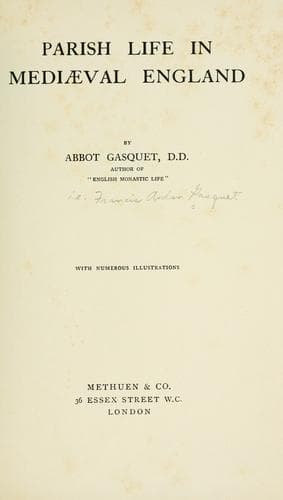
Parish life in mediæval EnglandGasquet, Francis Aidan
History
Parish life in mediæval England
Gasquet, Francis Aidan
England -- Church history -- 1066-1485; England -- Social life and customs -- 1066-1485
Devon, in their fourth article, demanded should be restored: “We will
have the Sacrament hang over the altar, and there to be worshipped.”
[Illustration: PYX, AND CANOPY, OPEN]
In the wills of the fifteenth century we have instances of rich stuffs
and silks being left for the covering of the Sacred Vessel, and of
gold and jewels for the pix itself. In a will of Elizabeth Bigod,
for instance, is the following item: “To the monastery of Croxton my
chain of gold to make a pyx for the Sacrament of the altar, and there
to be graven about the said pyx this: _Abbot and convent of the same
place, pray for the soul of Dame Elizabeth Bigod_.” In 1496 “Mr. Doctor
Hatclyff, parson,” of St. Mary-at-Hill in London, gave into the hands
of the wardens “a pyx clothe for the high auter, of sipers frenged
with gold, with knoppis of golde and sylke of Spaynesshe makyng.” And
at the same time two other coverings were made for this pyx; one of
“green sylk and red, with knoppis sylver and gylt with corners goyng,
of Mistress Duklyng’s gyffte,” and the other “of red velvelt with three
crowns of laton.” How carefully these presents were preserved may be
judged by an entry of 2_d._ in the accounts of 1513--seventeen years
later--“for mending the pyx cloth that Mistress Duklyng gave the High
Altar.”
[Illustration: PYX CANOPY, CLOSED]
The frontal of the altar made of silk or velvet, or in some instances
of metal with jewels, was by law to be found by the parishioners;
and numerous gifts are recorded of rich stuffs and velvets to vest
the altar with becoming honour. The same in practice may be said
of the other ornaments, which, although perhaps in strict law the
parishioners were not bound to provide, they nevertheless did find
very generally and very generously. The fee payable to the bishop for
the consecration of an altar after rebuilding or reconstruction is
found as an item of expense in the accounts of the parish wardens. So,
too, are the more constant fees, for the blessing of altar cloths and
other altar linen and the hallowing of vestments, paid to the parson
by the parish, as well as the occasional payment to a bishop for the
consecration of the parish chalice.
On the altar between the two big candlesticks stood the crucifix. The
author of _Dives and Pauper_ explains why this should be upon the table
of every altar in the following dialogue:--
“When a priest sayeth his Mass at the altar, commonly there is an
image before him, and commonly it is a crucifix, stone, or tree, or
portrayed”--(that is, of course, in stone, wood, or painting).
“_Dives._--Why more a crucifix than another thing?
“_Pauper._--For every Mass saying is a special mind-making of Christ’s
passion.
“_Dives._--The skyle is good; say forth.
Public-domain text, read in full here on John Shaqi.
Reviews
Reviews
No reviews yet
Be the first to share your thoughts on this work.
Join the Discussion
Join the discussion
Sign in to leave a comment or review.
Sign InorCreate an account