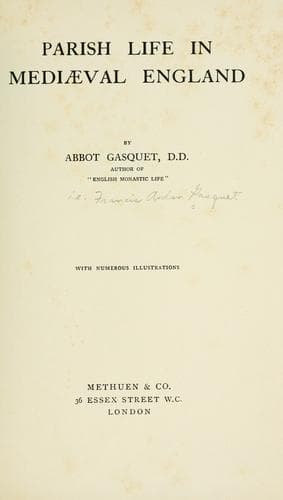
Parish life in mediæval EnglandGasquet, Francis Aidan
History
Parish life in mediæval England
Gasquet, Francis Aidan
England -- Church history -- 1066-1485; England -- Social life and customs -- 1066-1485
“the Catholic Church spread over the world believes in the
resurrection of the bodies of the dead. These have been sanctified by
the reception of the Sacraments, and are consequently buried, not in
profane places, but in specially enclosed and consecrated cemeteries,
or in churches, where with due reverence they are kept, like the
relics of the Saints, till the day of the resurrection.”
The trees that grew within the precincts of the cemetery were at times
a fertile cause of dispute between the priest and his people. Were they
the property of the parson or of the parish? And could they be cut down
at the will of either? In the thirteenth century, when the charge of
looking after the churchyards was regarded as weighing chiefly on the
clergy, it was considered that to repair the church--either chancel or
nave--the trees growing in them might be cut. Otherwise, as they had
been planted for the purpose of protecting the churches from damage by
gales, they were to be left to grow and carry out the end for which
they had been placed there. Archbishop Peckham had previously laid
down the law that, although the duty of keeping the enclosure of the
cemetery rested upon the parishioners, what grew upon holy ground
being holy, the clergy had the right to regard the grass and trees
and all that grew in the cemetery as rightly belonging to them. In
cutting anything, however, the archbishop warned the clergy to remember
that these things were intended to ornament and protect God’s house,
and that nothing should be cut without reason. However the question
of the ownership of the trees growing in churchyards may have been
regarded by the parishioners, there are evidences to show that they
did not hesitate to adorn their burial-places with trees and shrubs
when needed. At St. Mary’s, Stutterton, for instance, in 1487, the
churchwardens purchased seven score of plants from one John Folle, of
Kyrton, and paid for “expenses of settyng of ye plants, 16_d._”
The sacred character of consecrated cemeteries was recognized by
the law. Bracton says that “they are free and absolute from all
subjection, as a sacred thing, which is only amongst the goods of
God--whatever is dedicated and consecrated to God with rites and by
the pontiffs, never to return afterward to any private uses.” And
amongst these he names “cemeteries dedicated, whether the dead are
buried therein or not, because if those places have once been dedicated
and consecrated to God, they ought not to be converted again to human
uses.” Indeed, “even if the dead are buried there without the place
having been dedicated or consecrated, it will still be a sacred place.”
Public-domain text, read in full here on John Shaqi.
Reviews
Reviews
No reviews yet
Be the first to share your thoughts on this work.
Join the Discussion
Join the discussion
Sign in to leave a comment or review.
Sign InorCreate an account