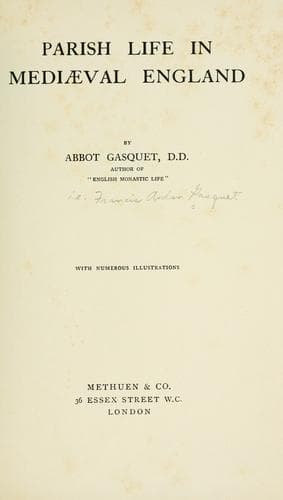
Parish life in mediæval EnglandGasquet, Francis Aidan
History
Parish life in mediæval England
Gasquet, Francis Aidan
England -- Church history -- 1066-1485; England -- Social life and customs -- 1066-1485
The head of every parish in pre-Reformation days was the priest. He
might be a _rector_ or _vicar_, according to his position in regard to
the benefice; but in either case he was the resident ecclesiastical
head of the parochial district. The word “parson,” in the sense of
a dignified personage--“the person of the place”--was, in certain
foreign countries, applied in the eleventh century, in its Latin form
of _persona_, to any one holding the parochial cure of souls. English
legal writers, such as Coke and Blackstone, have stated the civil law
signification of the word as that of any “person” by whom the property
of God, the Patron Saint, the church or parish was held, and who could
sue or be sued at law in respect to this property. In ecclesiastical
language, at any rate in England, according to Lyndwood, the word
“parson” was synonymous with “rector.”
Besides the rector or parson and the vicar, several other classes of
clergy were frequently to be met with in mediæval parishes. Such were
curates, chantry priests, chaplains, stipendiary priests, and sometimes
even deacons and subdeacons. About each of these and their duties and
obligations it will be necessary to speak in turn, but before doing so
something may usefully be said about the clergy generally, and about
their education, obligations, and method of life. From the earliest
times the clerical profession was open to all ranks and classes of
the people. Possibly, and even probably, the English landlords of
the fourteenth or fifteenth centuries were only too glad to bestow
livings, of which they had the right of presentation, upon younger
sons or relations, who had been educated with this end in view. But
in those same centuries there is ample evidence that the ranks of the
clergy were recruited from the middle classes, and even from the sons
of serfs, who had to obtain their overlord’s leave and pay a fine to
him for putting their children to school, and thus taking them from the
land to which they were by birth _adscripti_, or bound. Mr. Thorold
Rogers has given instances of the exaction of these fines for sending
sons to school. In one example 13_s._ 4_d._ was paid for leave to put
an eldest son _ad scholas_ with a view of his taking orders; in another
5_s._ was paid, in 1335, for a similar permission for a younger son.
In the diocesan registers, also, episcopal dispensations _de defectu
natalium_ are frequent, and show that a not inconsiderable number of
the English clergy sprang from the class of “natives” of the soil, or
serfs, upon whom the lord of the manor had a claim. Examples also could
be given of a bishop allowing his “native” (_nativus meus_) permission
to take sacred orders and to hold ecclesiastical benefices--acts of
kindness on the bishops’ part shown to some promising son of one of the
serfs of the episcopal domains.
Public-domain text, read in full here on John Shaqi.
Reviews
Reviews
No reviews yet
Be the first to share your thoughts on this work.
Join the Discussion
Join the discussion
Sign in to leave a comment or review.
Sign InorCreate an account