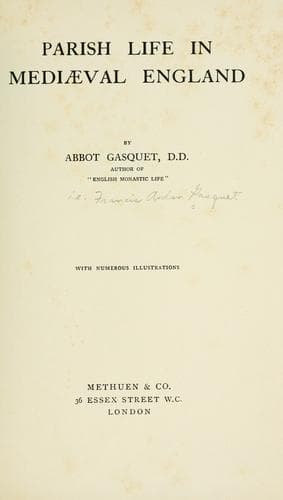
Parish life in mediæval EnglandGasquet, Francis Aidan
History
Parish life in mediæval England
Gasquet, Francis Aidan
England -- Church history -- 1066-1485; England -- Social life and customs -- 1066-1485
It is unnecessary to pursue the subject of the education of the
parochial clergy further. After his elementary education had been
received in the schools, the student’s preparation for the reception of
Orders was continued and completed at the Universities. The ordinary
course here was lengthy. Grammar, which included Latin and literature
with rhetoric and logic, occupied four years. The student was then
admitted a Bachelor. In the case of clerical students this was followed
by seven years’ training before the Bachelor’s degree in Theology was
bestowed, and only after a further three years’ study of the Bible,
and after the candidate had lectured at least on some one book of the
Scriptures, was he considered to have earned his degree of Doctor in
Theology.
[Illustration: ACOLYTHES]
[Illustration: SACRAMENT OF BAPTISM]
The age when the candidate for Orders could be promoted to the various
steps leading to the priesthood was settled by law and custom. A
boy of seven, if he showed signs of having a vocation to the sacred
ministry, might be made a cleric by receiving the tonsure. In “rare
instances” and under special circumstances he might then receive an
ecclesiastical benefice, and so get the wherewith to live while he was
studying to fulfil the duties attached to his office. In the course
of the next seven years the youth could be given the minor Orders of
“doorkeeper,” “lector,” “exorcist,” and “acolyte.” He would then be at
least fourteen years of age, and thus at the time of life at which in
those days students were supposed to begin their University course. At
eighteen the candidate to the priesthood might be ordained Subdeacon;
at twenty he could take the diaconate, and at twenty-five be ordained
Priest. It will be noticed that these ages in some way generally
correspond to the academic degrees. Going to the University at
fourteen, a clerical student might have, and no doubt frequently had,
received the various steps of minor Orders. Four years of the liberal
arts enabled him at eighteen to take his degree of Bachelor of Arts.
It was at this age that he could be ordained Subdeacon. Then seven
years of theological study enabled him to become a Bachelor of Divinity
at twenty-five, at which time he was of the right age to receive the
priesthood. This was the regular course; but without doubt the greater
number of candidates for the ministry did not pass through all the
schools. Some, no doubt, after entering sacred Orders, became attached
to cathedrals, colleges of priests, and even parochial churches, where,
in the midst of a more or less active life, they prepared themselves
for further ecclesiastical advancement. Wherever they were, however,
they would have to prove themselves to be sufficiently lettered
and of good life before they would be accepted for Ordination, and
their examination and proof was put as a conscientious duty upon the
bishop before he determined upon accepting and ordaining them. For
Public-domain text, read in full here on John Shaqi.
Reviews
Reviews
No reviews yet
Be the first to share your thoughts on this work.
Join the Discussion
Join the discussion
Sign in to leave a comment or review.
Sign InorCreate an account