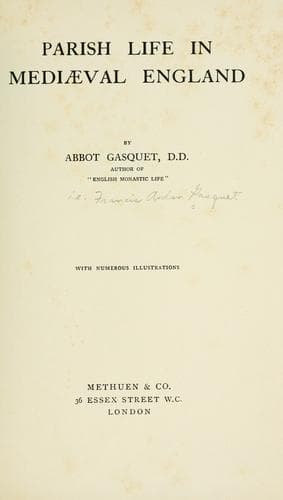
Parish life in mediæval EnglandGasquet, Francis Aidan
History
Parish life in mediæval England
Gasquet, Francis Aidan
England -- Church history -- 1066-1485; England -- Social life and customs -- 1066-1485
It is evident, from what is set out in the _Valor Ecclesiasticus_, that
the vicar proper, if he found it necessary, had to provide help in the
way of a curate. In this there was no distinction between a rector and
a vicar; and it is obvious that, where this was required, provision for
it had been made in the arrangement which had been come to in the first
instance between the impropriators and the bishop; or that arrangement
had subsequently been modified to enable the vicar to meet the expense
of extra help.
_Curates._--Next in importance among the parochial clergy come the
assistant priests, known as _Curates_ (_curati_), or those entrusted
with the cure of souls. They are called in canon law _vice curati_, or
_capellani_, who “administer the sacraments, not in their own name,
but in the name of another”--that is, in the name of the rector or
perpetual vicar. They were also, as previously pointed out, in England
occasionally called vicars, in the sense of taking the place of the
rector, etc.
Every curate by law was to receive from the rector or vicar who
employed him a fixed and sufficient salary, and all manner of bargains
as to payment or contracting out of obligations were prohibited.
Thus in the acts of the Synod of Ely, in 1364, Bishop Simon Langham
says, “We strictly prohibit any rector from making a bargain with his
(assistant) priest of this kind: that besides his fixed stipend he may
take offerings for anniversary Masses, etc., since such a bargain is a
clear indication that the fixed stipend is too small”--and to make it
up, these fees are looked for, and the parish Masses may be neglected.
In fact, by the Constitution of Archbishop Courtney, in 1391, the
curates were to receive none of the oblations, fees, or offerings made
in a parish, for services for which they received a sufficient payment
from those who employed them.
According to the same Constitution, the curate was admitted to his
office by the rector or vicar on any Sunday or Feast-day before the
parishioners at the parochial mass. After the Gospel of the Mass the
curate took an oath to respect the above conditions as to fees, etc.,
in the parish church or any chapel of ease in which he celebrated Mass,
and declared that he would neither stir up nor take part in any quarrel
or misunderstanding between the rector and his people; but that, on the
contrary, he would ever strive to preserve both peace and love between
them.
Public-domain text, read in full here on John Shaqi.
Reviews
Reviews
No reviews yet
Be the first to share your thoughts on this work.
Elsewhere in the archive
Join the Discussion
Join the discussion
Sign in to leave a comment or review.
Sign InorCreate an account