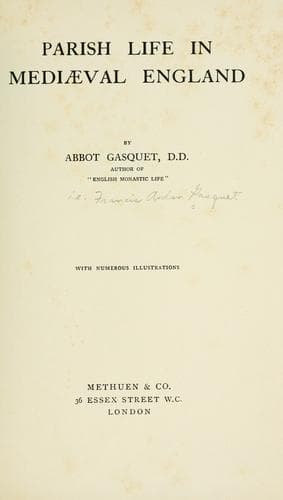
Parish life in mediæval EnglandGasquet, Francis Aidan
History
Parish life in mediæval England
Gasquet, Francis Aidan
England -- Church history -- 1066-1485; England -- Social life and customs -- 1066-1485
A curate thus instituted could only hear the confessions of
parishioners in the church or chapel where he said Mass according to
the leave and permission he had received; he was bound to be present
in the choir of the parish church, vested in a surplice, at Matins,
High Mass, Vespers, and other Divine service at the appointed hours on
Sundays and festivals, together with the other ministers of the church,
who were legally bound to assist at and increase the numbers of those
present at these services, and not to remain in the nave or walk about
in the cemetery, etc. On Sundays and Feast-days, when a funeral Mass
had to be said, the curate, unless with leave of his rector, was not
allowed to begin this Mass until after the Gospel of the High Mass.
In their private lives curates were warned always to act as priests,
and not to frequent taverns, plays, or illicit spectacles. In dress
and carriage they were ever to uphold the credit of the ecclesiastical
state, and not to bring scandal upon their rectors or upon themselves.
Sometimes the need of extra assistance in the parish was felt by the
people, and very frequently they contributed the sum necessary for a
curate’s sufficient stipend. At times the people even appealed to the
bishop to force the parson to seek additional help. Thus in the diocese
of London, in the fourteenth century, there is recorded the complaints
of the inhabitants of a parish that their vicar would not allow the
services of a priest for whom they had paid, and that thus “they were
deprived of daily Mass, and other divine service, with the sacraments
and sacramentals.”
At times, indeed, the need of an assistant in a parish was so obvious
that the bishop felt bound to interfere in order to secure the
appointment. Thus Bishop Rigaud de Asserio, of Winchester, in 1323,
appointed a curate to the Vicar of Twyford, “who was suffering from
an incurable disease” and unable to do the work of his parish. In the
same way, in 1313-14, Bishop Stapledon, of Exeter, appointed a curate
coadjutor to the Vicar of St. Neots, who was found to be suffering
from leprosy. The vicar was to have a certain stipend; was to keep the
best room in the parsonage, with the adjoining parts of the house,
except the hall. The door between this room and the vicar’s chamber was
to be built up, and the newly appointed curate was to have the whole
administration of the vicarage.
Public-domain text, read in full here on John Shaqi.
Reviews
Reviews
No reviews yet
Be the first to share your thoughts on this work.
Elsewhere in the archive
Join the Discussion
Join the discussion
Sign in to leave a comment or review.
Sign InorCreate an account