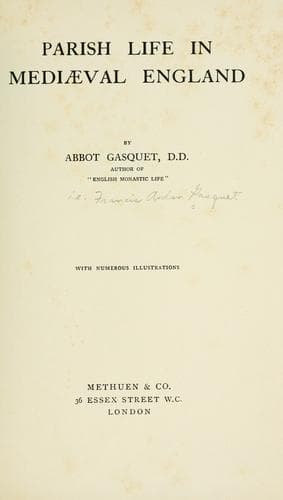
Parish life in mediæval EnglandGasquet, Francis Aidan
History
Parish life in mediæval England
Gasquet, Francis Aidan
England -- Church history -- 1066-1485; England -- Social life and customs -- 1066-1485
The _Chantry Priest_.--Next in order of importance among the priests of
a mediæval parish come the clergymen serving any chantry attached to
the church. These chantry chapels were, as is well known, very numerous
in pre-Reformation days, particularly in towns; but it has hitherto not
been sufficiently recognised that the priests serving them in any way
helped in parochial work. This is simply because the purpose, for which
those adjuncts to parish churches existed, has not been understood.
We have been taught to believe that a “chantry” only meant a place
(chapel or other locality) where Masses were offered for the repose of
the soul of the donor, and other specified benefactors. No doubt there
were such chantries existing, but to imagine that they were even the
rule is wholly to mistake the purpose of such foundations. Speaking
broadly, the chantry priest was an assistant priest of the parish, or,
as we should nowadays say, curate of the parish, who was supported by
the foundation fund of the benefactors for that purpose, and indeed
not unfrequently even by the contributions of the inhabitants. For
the most part their _raison d’être_ was to look after the poor of the
parish, to visit the sick, and to assist in the functions of the parish
church. Moreover, connected with these chantries were very commonly
what were called “obits.” These were not, as we have been asked to
believe, mere money payments to the priest for some anniversary
services; but they were for the most part money left quite as much for
annual alms to the poor, as for the celebration of any anniversary
offices. Let us take a few examples. In the city of Nottingham there
were two chantries connected with the parish church of St. Mary’s, that
of Our Lady, and that called Amyas Chantry. The former, we are told,
was founded “to maintain the services and to be an aid to the vicar,
and partly to succour the poor;” the latter for the priest to assist in
“God’s service,” and to pray for William Amyas, the founder. When the
commissioners in the first year of Edward VI. came to inquire into the
possessions of these chantries, they were asked by the people of the
place to note that in this parish there were “1400 houseling people,
and that the vicar there had no other priest to help but the above two
chantry priests.” It is not necessary to say that these foundations
were not spared on this account; for within two years the property,
upon which these two priests were supported, had been sold to two
speculators in suchlike parcels of land--John Howe and John Broxholme.
Public-domain text, read in full here on John Shaqi.
Reviews
Reviews
No reviews yet
Be the first to share your thoughts on this work.
Elsewhere in the archive
Join the Discussion
Join the discussion
Sign in to leave a comment or review.
Sign InorCreate an account