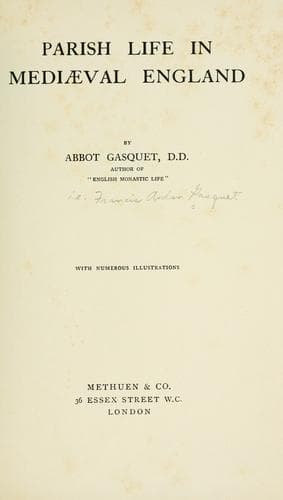
Parish life in mediæval EnglandGasquet, Francis Aidan
History
Parish life in mediæval England
Gasquet, Francis Aidan
England -- Church history -- 1066-1485; England -- Social life and customs -- 1066-1485
Then, again, in the parish of St. Nicholas, at Nottingham, we find from
the returns of the Commissioners that the members of the “Guild of the
Virgin” contributed to the support of an extra priest. In the parish
there were “more than 200 houseling people,” and as the parish living
was very poor, there was no other priest to look after them but this
one, John Chester, who was paid by the Guild. The King’s officials,
however, did not hesitate on this account to confiscate the property.
It is useless to multiply instances of this kind, some hundreds of
which might be given in the county of Nottingham alone. It may be
interesting, however, to take one or two examples of “obits” in this
part of England. In the parish of South Wheatley there were parish
lands let out to farm, which produced 18_d._ a year; say from £1 to
£1 4_s._ of our money. Of this sum, 1_s._ was for the poor and 6_d._
for church lights; that is, two-thirds, or, say, 16_s._ of our money,
was for the relief of the distressed. So in the parish of Tuxford the
church “obit” lands produced £1 5_s._ 4_d._, or more than £16 a year;
of this 16_s._ 4_d._ was intended for the poor, and 9_s._ for the
church expenses. It is almost unnecessary to add that the Crown took
the whole sum; that intended for the poor, as well as that used for
the support of the ecclesiastical services. Neither can it be held, I
fear, that the robbery of the poor was accidental and unpremeditated.
It has been frequently asserted, of course, that although grave
injury was undoubtedly done to the poor and needy in this way, it was
altogether inevitable, since the money thus intended for them was so
inextricably bound up with property to which religious obligations
(now declared to be superstitious and illegal) were attached, that the
whole passed together into the royal exchequer. It would be well if it
could be shown that this spoliation of the sick and needy by the Crown
of England was accidental and unpremeditated; but there are the hard
facts which cannot be got over. The documents prove unmistakably that
the attention of the officials was drawn to the claims of the poor,
and that in every such case these claims were disregarded, and a plain
intimation was given that the Crown deliberately intended to take even
the pittance of the poor.
The _Stipendiary_ priest differed in little from the curate, except
that he was engaged and paid for some special service and not for
the general purposes of a parish like a curate. They (_i.e._ the
stipendiaries) live, says Lyndwood, upon the stipend paid them for
their service, and have no fixed title or claim upon the church where
they offer up their Mass, except that they are paid for doing so for
a year or other fixed time. They had no claim whatever to fees or
oblations, and indeed, they were prohibited from receiving them.
Public-domain text, read in full here on John Shaqi.
Reviews
Reviews
No reviews yet
Be the first to share your thoughts on this work.
Elsewhere in the archive
Join the Discussion
Join the discussion
Sign in to leave a comment or review.
Sign InorCreate an account