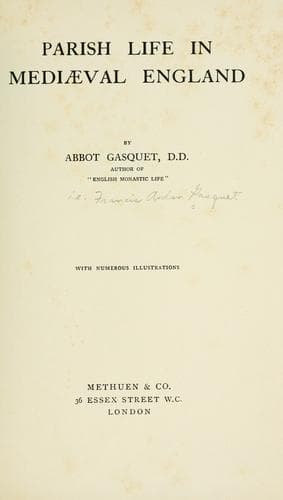
Parish life in mediæval EnglandGasquet, Francis Aidan
History
Parish life in mediæval England
Gasquet, Francis Aidan
England -- Church history -- 1066-1485; England -- Social life and customs -- 1066-1485
Like all other priests dwelling within the bounds of a parish,
Stipendiaries were bound to attend in the choir of the parochial
church in surplice at Matins, High Mass, Vespers, and at all other
public Divine service. They were to be ready to read the lessons, sing
in the psalms and other chants, or take any other part, according to
the disposition of the rector or vicar. Some entries in the Chantry
certificates show that this duty was understood and fulfilled to the
end. At Costessy, in Norfolk, to take but one example, a stipendiary
priest was paid £6 by King’s College, Cambridge, to offer Mass in a
Free chapel, for the convenience of the people at a distance, and the
certificate adds, “and the said priest hath always used to help the
curate sing divine service upon holy day in the parish church.”
_Chaplain_ was a name given apparently to two sets of priests. The
priest employed, by a nobleman or other person of distinction, to
say Mass in a private chapel, and the priest who served a chapel of
ease, established for the convenience of the people in a much extended
parish, were both designated chaplains. Of the first, it is only
necessary to say, that so far at the parish was concerned, it could
claim the presence and help of even all private chaplains at the
ordinary services of the church.
The public chaplains, or those who served in chapels of ease, were
of greater importance in parochial work. The necessity for these
chapelries appears clearly in the “Chantry certificates,” under colour
of the act for suppressing which most of the chapels were destroyed.
Thus to take a few examples: The “Free chapel” of Tylne, in the parish
of Hayton, in Cumberland, had been founded by a priest named Robert
Poore. It had “always been accustomed to have all manner of Sacraments
ministered by the chaplain there to the inhabitants of North and
South Tylne. By reason that many times in the year such influence
of waters and snow doth abound so much within the said hamlets, the
inhabitants thereof can by no means resort unto their parish church
of Hayton, being two miles distant from the said chapel, neither for
christening, burying, or other rites.” And again at South Leverton, in
Nottinghamshire, there was a “chapel of Cottam, a mile distant from
the parish church,” at which eighty people received the Sacraments.
And, adds the “certificate,” “many times the waters being up the people
cannot come to their parish church.”
Public-domain text, read in full here on John Shaqi.
Reviews
Reviews
No reviews yet
Be the first to share your thoughts on this work.
Elsewhere in the archive
Join the Discussion
Join the discussion
Sign in to leave a comment or review.
Sign InorCreate an account