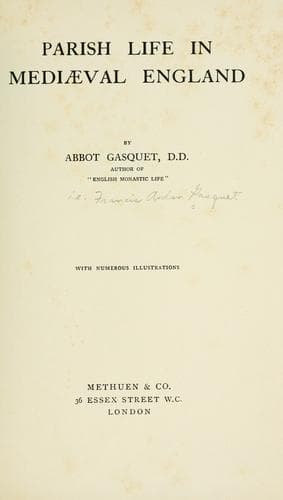
Parish life in mediæval EnglandGasquet, Francis Aidan
History
Parish life in mediæval England
Gasquet, Francis Aidan
England -- Church history -- 1066-1485; England -- Social life and customs -- 1066-1485
Besides the above-named priests, all more or less connected with
the working of a mediæval parish, it was ordered that, wherever the
means of the place would allow it, there should be always a deacon
and subdeacon to assist in the due celebration of the Divine service.
Chance references in accounts and other documents seem to show that
they were often so employed. In one set of churchwardens’ accounts
there is a curious entry of receipt from a deacon, who pays for damage
done to certain vestments at the time of his ordination. In another,
a collection was made from the parishioners for the support of the
deacon; and in a book of directions for clerics, it is laid down as
part of the deacon’s office to bring the pyx containing the Blessed
Sacrament from behind the altar, where it had been hanging, and to
place it on the table of the altar for the priest to communicate the
faithful.
CHAPTER V
THE PARISH OFFICIALS
If the parish priest, rector, or vicar was undoubtedly the admitted
centre of life in the district, the father of his people and the pastor
of his flock, neither on his part nor on that of the parishioners
was there any mistake about the rights and duties of the people
to the parish church and towards parish matters generally. Within
well-defined limits, the parish, which included both parson and people,
managed its own affairs. Every adult of both sexes had a voice in
this self-government, and, as Bishop Hobhouse has pointed out, in
pre-Reformation days a wise freedom in the management of the fabric
of the church and its accessories seemed to have been left to the
parish by the diocesan authorities. They--the people--encouraged by
every means in their power, and indeed frequently initiated, those
manifestations of zeal for beautifying God’s house which form so
remarkable a feature in the architectural history of the fifteenth and
early sixteenth centuries. Moreover, it is impossible to turn over the
church accounts of that period which have come down to us, without
acknowledging that the love of the people for their parish churches
was supported and intensified by the feeling that it was their work,
and that upon each of them in conscience lay the duty of assisting to
maintain the sanctuary, where, according to their strong and simple
faith, God dwelt in their midst, and of helping to keep up within this
holy place the round of prayers and praise and sacrifice.
This common purpose of all within a parish was in those days not left
to be carried out by chance or by mere individual effort; it was
highly and intelligently organised to secure the co-operation and the
continual contributions necessary for successfully carrying out the
work. For this end certain officials were chosen by popular election as
the people’s representatives, others were appointed in various ways and
others, again, were employed as their services were required.
Public-domain text, read in full here on John Shaqi.
Reviews
Reviews
No reviews yet
Be the first to share your thoughts on this work.
Elsewhere in the archive
Join the Discussion
Join the discussion
Sign in to leave a comment or review.
Sign InorCreate an account