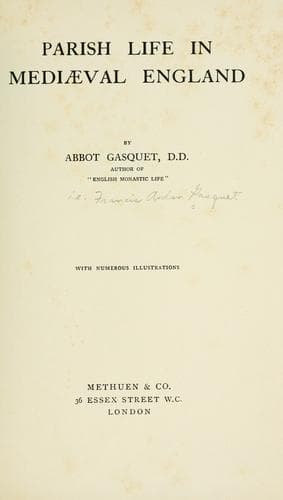
Parish life in mediæval EnglandGasquet, Francis Aidan
History
Parish life in mediæval England
Gasquet, Francis Aidan
England -- Church history -- 1066-1485; England -- Social life and customs -- 1066-1485
The second “deacon” or clerk, commonly called “the fellow” of the first
in this document, has also his special duties assigned. Every week-day
he is to ring the second peal for Matins at half-past six. He is to see
to the books on the north side of the choir, and sing on that side as
the first “deacon” does for the south. At Evensong he shall do in like
manner, but “he shall be subdeacon every Sunday and Holy-day at the
procession and Mass, and read the Epistle.” Generally he is to assist
the “deacon” with the choir books and processionals, and help to fold
up the vestments and albs, etc.
Beyond the above-named parish officials there were obviously, many
others whose services were occasionally required. Amongst others are:
The _Sexton_, whose office was what it remains at the present day. Such
an official is named, in 1490, in the parish accounts of Cratfield; but
the extremely rare mention of the name seems to show that in a mediæval
parish each individual family interested saw to the preparation of the
last resting-place of any of their dead relations.
The _Schoolmaster_, or, at any rate, one who occupied the place of a
teacher of the young, is more frequently named in connection with the
parish than many people would be inclined to believe. An examination
of the records of parish life contained in the invaluable _Valor
Ecclesiasticus_ will reveal the fact of the existence of both grammar
and song schools in many places in the sixteenth century. At Preston,
in Amounderness, for instance, a chantry priest was bound to keep a
“free grammar school” for the parish, and at the suppression of the
chantry, the lands left to support this were seized by the Crown. The
official returns by the Commissioners for suppressing the chantries
afford many examples of these schools taught by priests and by clerks.
These generally, no doubt, existed by reason of special foundations
made by generous benefactors for the purpose; but in one case at
least, at Lavenham, “the alderman of St. Peter’s Guild” finds a priest
who “teaches the children of the said town and acts as secondary to the
curate, who, without help of another priest, is not able to serve the
cure there.”
The _Bell-ringer_ was an important official in every parish. His first
duty was to ring for the services in the church, and to toll the bell
for deaths, funerals, obits, or anniversary services. If his wages were
paid by the parish, his labours were in most places one of the sources
of income by which the parish chest was replenished, as the fees
charged brought in more than the amount paid to him. In some places,
besides his duty in regard to the bells, he was appointed to look after
various lamps or lights. Thus at Swaffham, in Norfolk, one Simon Blake
appoints “a lamp to burn by his grave on all holidays and Lord’s days,
from Matins to Compline, and the bellman of the town of Swaffham to
take care of it.”
Public-domain text, read in full here on John Shaqi.
Reviews
Reviews
No reviews yet
Be the first to share your thoughts on this work.
Elsewhere in the archive
Join the Discussion
Join the discussion
Sign in to leave a comment or review.
Sign InorCreate an account