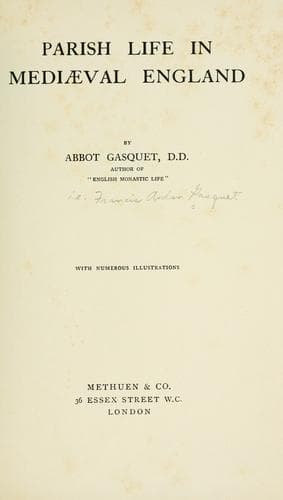
Parish life in mediæval EnglandGasquet, Francis Aidan
History
Parish life in mediæval England
Gasquet, Francis Aidan
England -- Church history -- 1066-1485; England -- Social life and customs -- 1066-1485
One of the most regular sources of parochial receipt was the fee for
burial in the church or churchyard. To judge from several entries
in various accounts, the cost of opening a grave in the nave of the
church was 6_s._ 8_d._, which belonged to the parish. Thus at St.
Mary’s, Cambridge, in 1515, in the churchwardens’ receipts there are
two such items, one for the burial of Calo Fremeston, and the other
for that of a “Mr. Wise.” In London, as we might perhaps expect,
the fee was greater; in fact, in the accounts of St. Mary-at-Hill,
in 1522-3, among the “Casuell Resceites” are entered those “for the
buryall of John Colers in the chirche, 13_s._; for the buryall of
William Holyngworthi’s child, 2_s._; for the buryall of a stranger
in the great churchyard, 12_d._; for the buryall of a priest in the
pardon churchyard, 2_s._; for the buryall of Robert Hikman in St.
Ann’s Chapel, 13_s._ 4_d._” This same year a regular table of “fees
to be paid” to the parish for burials in the church, churchyard, or
pardon-churchyard attached to the church of St. Mary’s was drawn up.
From this we learn that for every grave opened, in either of the two
chapels of St. Stephen and St. Katherine, 13_s._ 4_d._ was to be paid:
for every man, woman, and child buried “without the choir door of any
of the said chapels ... unto the west door of the aisle going south
or north,” 10_s._ was to be paid; and for any burial “from the cross
aisle to the west end of the church,” 6_s._ 8_d._ The price of the
ground thus varied according to the position, and similarly the clerk’s
fee varied for breaking the ground: it was 3_s._ 8_d._ in the first
case, 2_s._ 6_d._ in the second, and 1_s._ 8_d._ in the third. These
payments, of course, had nothing to do with the fee of the clergyman:
this was fixed at 1_d._ as a minimum, but generally more was given
according to the means of the family. The smallness of the fee may
perhaps be explained by the English custom of “mortuaries,” that is,
the gift of the best or second best possession of the deceased to the
church.
“In some places (says Bracton) the church has the best beast, or the
second or the third best, and in some places nothing; and therefore
the custom of the place is to be considered ... and although no one is
bound to give anything to the church for burial, nevertheless, where
the laudable custom exists the Lord the Pope does not wish to break
through it.”
Public-domain text, read in full here on John Shaqi.
Reviews
Reviews
No reviews yet
Be the first to share your thoughts on this work.
Elsewhere in the archive
Join the Discussion
Join the discussion
Sign in to leave a comment or review.
Sign InorCreate an account