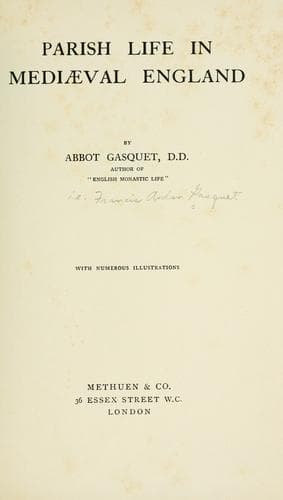
Parish life in mediæval EnglandGasquet, Francis Aidan
History
Parish life in mediæval England
Gasquet, Francis Aidan
England -- Church history -- 1066-1485; England -- Social life and customs -- 1066-1485
A further source of income was found towards the beginning of the
sixteenth century when the letting of pews or seats in the church
became a custom. The revenue from this was always successfully claimed
by the wardens in behalf of the parishioners, on the ground, no doubt,
that the nave of the church where these seats had been erected was
their property, and that the fee for the exclusive right of any special
portion belonged to them, on the same principle as the money for the
sale of any particular part for a grave. This practice of letting pews
for the use of individuals has already been sufficiently illustrated by
examples.
The practice of leaving sums of money by will to the wardens for
definite purposes was almost universal in the last half of the
fifteenth century and at the beginning of the sixteenth. In the
accounts of St. Mary-at-Hill, in London, are to be found such entries
as: “Received of William Blase, Barbowrez (_i.e._ the barber’s) wife,
for painting of an image of Our Lady within the Church--20_d._,”
and many other examples have previously been given of sums left by
deceased parishioners for special work in their parish churches, such
as the erection or adornment of the rood or its loft. Bishop Hobhouse
has noticed in the Somerset churchwardens’ accounts that there was
hardly any conceivable kind of property that was not handed over to
the wardens for church purposes, either to produce income by being
leased out, or to be sold for the benefit of the common exchequer. Live
stock of every sort is represented--cows, oxen for ploughing, rams,
sheep, lambs, bees, cocks and hens, geese, and even pigs are named.
At Morebath almost every altar had its endowment of sheep, and at St.
Mary’s, in the city of Bath, there was a little flock managed by the
wardens. In the former small parish there were no fewer than eight
different accounts kept, and “a supernumerary body” of from three to
nine parishioners were added to the wardens “as controllers of the
parish stock.” At Bromley, Margaret White, widow, who died in June,
1538, by her will gave to the church one hive of bees to support the
light of All Hallows, one hive to support the light of the Sepulchre,
and a third to the light of St. Anthony. Also to the keeping of her
obit she gave two kine, and directed that the obit should be kept
“out of the increase of the said kine,” and her name placed on the
bede-roll, and that Mass be said and bread and cheese and drink given
to four poor people.
Public-domain text, read in full here on John Shaqi.
Reviews
Reviews
No reviews yet
Be the first to share your thoughts on this work.
Elsewhere in the archive
Join the Discussion
Join the discussion
Sign in to leave a comment or review.
Sign InorCreate an account