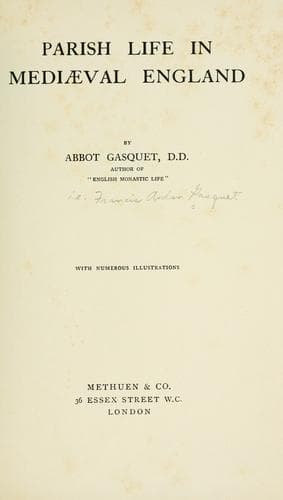
Parish life in mediæval EnglandGasquet, Francis Aidan
History
Parish life in mediæval England
Gasquet, Francis Aidan
England -- Church history -- 1066-1485; England -- Social life and customs -- 1066-1485
These early morning Masses were called by various names, of which
“Morrow Mass” and “Jesu Mass” were the most common. In the Chantry
Certificates a great number of entries of parcels of lands, etc., for
the support of some daily Mass in the early morning, show how popular
this service was in pre-Reformation days. In one place, in the county
of Nottingham, the chantry suppressed is declared to have been founded
for a priest “to say Mass every morning before sonne rysing, for such
as be travellers by the way, and to maintain God’s service there; which
town is also a thoroughfare towne.” At Barnards’ Castle, the Guild of
Holy Trinity paid for a priest “to say Mass daily at six o’clock in
the morning, and to be resident at Matins, Mass, and Evensong, and to
keep a free grammar school and a song school for all the children of
the town.” At Ipswich, “Mr. Alfrey’s chantry was founded for a priest
to sing the ‘Morowe Mass,’ in the parish church at St. Matthew;” whilst
at Newark the chantry priest of St. Mary Magdalene’s had to say Mass
for the people at 4 o’clock in the morning. Most of the instances
recorded show that the “Morrow Mass,” whether at daybreak or at 4 or
5 or 6 o’clock, was endowed by benefactors with the revenues of lands
or tenements. Sometimes, however, the stipend of the priest was paid
by money collected for the purpose from the parishioners. At Bury St.
Edmunds, for instance, the greater part of the necessary money for
the early-mass priest was “gathered wekely of the devotion of the
parishioners.” The churchwardens’ accounts of St. Edmund’s and St.
Thomas’s, Salisbury, show that a certain “fraternity” paid for a priest
to say “the Morrow Masse of Jesus,” they also paid for a torch and 6
lbs. of tallow candles for “the said Morrowe Masse prest in Wynter.” In
the parish of St. Peter-Cheap, London, the Wardens paid the stipend for
a curate to say Mass every morning at six o’clock, and the wages of a
clerk to serve him.
Public-domain text, read in full here on John Shaqi.
Reviews
Reviews
No reviews yet
Be the first to share your thoughts on this work.
Elsewhere in the archive
Join the Discussion
Join the discussion
Sign in to leave a comment or review.
Sign InorCreate an account