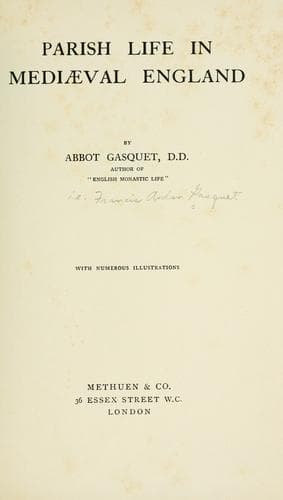
Parish life in mediæval EnglandGasquet, Francis Aidan
History
Parish life in mediæval England
Gasquet, Francis Aidan
England -- Church history -- 1066-1485; England -- Social life and customs -- 1066-1485
“Aryse be tyme oute of thi bedde,
And blysse thi brest and thi forhede,
Then wasche thi handes and thi face,
Keme thi hede, and aske God grace
The to helpe in all thi werkes;
Thou schall spede better what so thou confes,
Then go to ye chyrche, and here a masse.”
Andrew Borde also, in his _Regyment_, says that after rising and
dressing, “then great and noble men doth use to here Masse, and other
men that can not do so, but must apply theyr busyness, doth serve
God with some prayers, surrendrynge thankes to hym for hys manyfolde
goodnes, with askynge mercye for theyr offences.” In the Introduction
to _The Lay Folks Mass Book_ Canon Simons has gathered together a
considerable number of authorities for holding that people were
supposed to hear their daily Mass, with the exception of those “common
people,” who were employed on work and could only be present on the
Sundays and holidays. In Wynkyn de Worde’s _Boke of Kervynge_ the
chamberlain is instructed “at morne” to “go to the chyrche or chapell
to your soveraynes closet and laye carpentes and cuysshens and pute
downe his boke of prayers, then drawe the curtynes.” And so, too,
Robert of Gloucester says of William the Conqueror, reflecting the
manners of the time in which he himself wrote: “In chyrche he was
devout ynou, for hym non day abyde that he na hurde masse and matyns
and evenson[g] and eche tyde.” And Canon Simmons adds--
“But that the rule of the church was not a dead letter is perhaps most
unmistakably shown by the matter-of-course way in which hearing mass
before breaking fast is introduced as an incident in the everyday
life of knights and other personages in works of fiction, which,
nevertheless, in their details were no doubt true to the ordinary
habits of the class they intended to portray....”
For example, in _Sir Gawayne and the Green Knight_ Gawayne, after the
lady has kissed him--
“Dos hir forth at ye dore, with outen dyn more
And he ryches him to ryse and rapes hym sone,
Clepes to his chamberlayn, choses his wede
Bozez forth, quen he watz boun, blythely to Masse
And thenne he meued to his mete, that menskly hym keped.”
And so again the lord hears Mass before he eats, and goes hunting at
daybreak--
“Ete a sop hastyly, when he hade herde Masse
With bugle to bent felde he buskez by-lyve.”
Public-domain text, read in full here on John Shaqi.
Reviews
Reviews
No reviews yet
Be the first to share your thoughts on this work.
Elsewhere in the archive
Join the Discussion
Join the discussion
Sign in to leave a comment or review.
Sign InorCreate an account