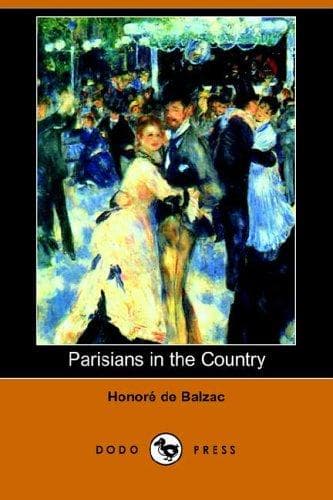
France -- Social life and customs -- 19th century -- Fiction
Produced by John Bickers, and Dagny
PARISIANS IN THE COUNTRY
THE ILLUSTRIOUS GAUDISSART,
AND THE MUSE OF THE DEPARTMENT
By Honore De Balzac
INTRODUCTION
I have sometimes wondered whether it was accident or intention which
made Balzac so frequently combine early and late work in the same
volume. The question is certainly insoluble, and perhaps not worth
solving, but it presents itself once more in the present instance.
_L’Illustre Gaudissart_ is a story of 1832, the very heyday of Balzac’s
creative period, when even his pen could hardly keep up with
the abundance of his fancy and the gathered stores of his minute
observation. _La Muse du Departement_ dates ten years and more later,
when, though there was plenty of both left, both sacks had been deeply
dipped into.
_L’Illustre Gaudissart_ is, of course, slight, not merely in bulk, but
in conception. Balzac’s Tourangeau patriotism may have amused itself by
the idea of the villagers “rolling” the great Gaudissart; but the ending
of the tale can hardly be thought to be quite so good as the beginning.
Still, that beginning is altogether excellent. The sketch of the
_commis-voyageur_ generally smacks of that _physiologie_ style of which
Balzac was so fond; but it is good, and Gaudissart himself, as well as
the whole scene with his _epouse libre_, is delightful. The Illustrious
One was evidently a favorite character with his creator. He nowhere
plays a very great part; but it is everywhere a rather favorable
and, except in this little mishap with Margaritis (which, it must
be observed, does not turn entirely to his discomfiture), a rather
successful part. We have him in _Cesar Birotteau_ superintending the
early efforts of Popinot to launch the Huile Cephalique. He was present
at the great ball. He served as intermediary to M. de Bauvan in the
merciful scheme of buying at fancy prices the handiwork of the Count’s
faithful spouse, and so providing her with a livelihood; and later as
a theatrical manager, a little spoilt by his profession, we find him
in _Le Cousin Pons_. But he is always what the French called “a good
devil,” and here he is a very good devil indeed.
Public-domain text, read in full here on John Shaqi.
Reviews
Reviews
No reviews yet
Be the first to share your thoughts on this work.
Join the Discussion
Join the discussion
Sign in to leave a comment or review.
Sign InorCreate an account