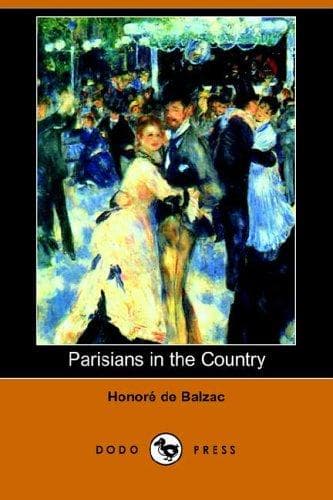
France -- Social life and customs -- 19th century -- Fiction
But I cannot think the scene of the Parisians _blaguing_ the Sancerrois
is a very happy one. That it is in exceedingly bad taste might not
matter so very much; Balzac would reply, and justly, that he had not
intended to represent it as anything else. That the fun is not very
funny may be a matter of definition and appreciation. But what scarcely
admits of denial or discussion is that it is tyrannously too long. The
citations of _Olympia_ are pushed beyond measure, beyond what is comic,
almost beyond the license of farce; and the comments, which remind one
rather of the heavy jesting on critics in _Un Prince de la Boheme_ and
the short-lived _Revue Parisienne_, are labored to the last degree. The
part of Nathan, too, is difficult to appreciate exactly, and altogether
the book does not seem to me a _reussite_.
The history of _L’Illustre Gaudissart_ is, for a story of Balzac’s,
almost null. It was inserted without any previous newspaper appearance
in the first edition of _Scenes de la Vie de Province_ in 1833, and
entered with the rest of them into the first edition also of the
_Comedie_, when the joint title, which it has kept since and shared with
_La Muse du Departement_, of _Les Parisiens en Province_ was given to
it.
_La Muse du Departement_ has a rather more complicated record than its
companion piece in _Les Parisiens en Province_, _L’Illustre Gaudissart_.
It appeared at first, not quite complete and under the title of _Dinah
Piedefer_, in _Le Messager_ during March and April 1843, and was almost
immediately published as a book, with works of other writers, under the
general title of _Les Mysteres de Province_, and accompanied by some
other work of its own author’s. It had four parts and fifty-two chapters
in _Le Messager_, an arrangement which was but slightly altered in the
volume form. M. de Lovenjoul gives some curious indications of mosaic
work in it, and some fragments which do not now appear in the text.
George Saintsbury
THE ILLUSTRIOUS GAUDISSART
Translated By Katharine Prescott Wormeley
DEDICATION
To Madame la Duchesse de Castries.
CHAPTER I
The commercial traveller, a personage unknown to antiquity, is one of
the striking figures created by the manners and customs of our present
epoch. May he not, in some conceivable order of things, be destined to
mark for coming philosophers the great transition which welds a period
of material enterprise to the period of intellectual strength? Our
century will bind the realm of isolated power, abounding as it does
in creative genius, to the realm of universal but levelling might;
equalizing all products, spreading them broadcast among the masses, and
being itself controlled by the principle of unity,--the final expression
of all societies. Do we not find the dead level of barbarism succeeding
the saturnalia of popular thought and the last struggles of those
civilizations which accumulated the treasures of the world in one
direction?
Public-domain text, read in full here on John Shaqi.
Reviews
Reviews
No reviews yet
Be the first to share your thoughts on this work.
Join the Discussion
Join the discussion
Sign in to leave a comment or review.
Sign InorCreate an account