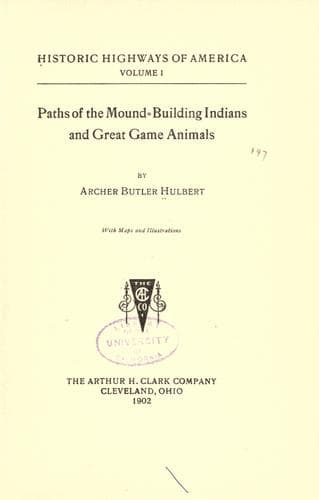
Paths of the Mound-Building Indians and Great Game AnimalsHulbert, Archer Butler
History
Paths of the Mound-Building Indians and Great Game Animals
Hulbert, Archer Butler
American bison; Indian trails -- United States; Mound-builders
Assuming, then, that the mound-building people lived (in these states
more particularly noticed) on the lesser "inland" streams where the
later Indians were found, there is no question but that they moved about
the country more or less as the Indians themselves did. Although the
former people were more nearly a stationary people, yet we know that
they hunted, and it is not reasonable to believe that they did not have
commercial intercourse. In fact, from the contents of their mounds, we
know they did. We also know that the various tribes made war upon one
another, or at least were made war upon by some enemy.
All this necessitated highways of travel. Any one who has studied the
West during Indian occupancy does not need to be asked to remember that
travel in the earliest days in the interior was by land as well as by
water. Those making long journeys at propitious seasons, such as the
Iroquois who went southward in war parties, the Moravians being
transferred to Ohio from Pennsylvania, pioneers en route down the Ohio
river to Kentucky, the Wyandots on their memorable hegira to the Detroit
river, used the waterways. But the main mode of travel for explorers,
war parties, pioneer armies and missionaries seems to have been by the
paths which threaded the forests.[9]
Of the hundreds of Indian forays into Virginia and Kentucky there is
perhaps not one, even those moving down the Scioto and up the Licking,
that used water transportation. In their hunting trips the canoe was
useless except for transporting game and peltry to the nearest posts,
and this was done often on the little Indian ponies.
For long months the lesser streams were ice-bound in the winter; in the
summer, for equally long periods, they must have been nearly dry, as in
the present era of slack-water navigation the larger of them are
frequently very low. Even travel on the Ohio in low-water months was
exasperatingly slow. One pilgrim to Ohio spent ninety days en route from
Killingly, Connecticut, to Marietta, Ohio--thirty-one of them being
spent in getting from Williamsport, Pennsylvania, down the Monongahela
and Ohio to Marietta! The journey from Connecticut in a cart drawn by
oxen to the Monongahela took but twice the time needed to come down the
rivers to Marietta on a "Kentucky" flatboat![10] With high-water, and
going down stream, a hundred miles a day could be covered.[11]
That the first pioneers into the interior of Ohio, Kentucky, and Indiana
preferred land routes to water is plain to the most casual reader of the
history of the pioneer period. Such great entrepots as Wellsburg, Ohio,
Limestone, Kentucky, and Madison, Indiana (all on the Ohio), attest the
fact that the travel to the interior was by land routes and not by the
smaller rivers.
Public-domain text, read in full here on John Shaqi.
Reviews
Reviews
No reviews yet
Be the first to share your thoughts on this work.
Join the Discussion
Join the discussion
Sign in to leave a comment or review.
Sign InorCreate an account