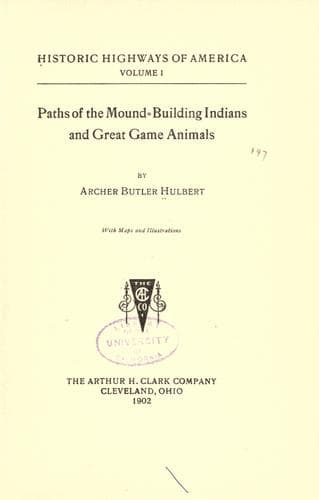
Paths of the Mound-Building Indians and Great Game AnimalsHulbert, Archer Butler
History
Paths of the Mound-Building Indians and Great Game Animals
Hulbert, Archer Butler
American bison; Indian trails -- United States; Mound-builders
The range of the buffalo or bison in the United States formerly extended
from Great Slave Lake on the north to the northeastern provinces of
Mexico on the south--from 62° latitude to 25°. Its westward range
extended beyond the Rocky mountains and embraced quite a large area,
remains having recently been discovered as far west as the Blue
mountains in Oregon; farther south, herds roamed over the region
occupied by the Great Salt Lake basin and grazed westward as far as the
Sierra Nevada mountains. East of the Rocky mountains the feeding-grounds
embraced all the area drained by the Ohio river and its tributaries,
extending southward beyond the Rio Grande and northward to the Great
Lakes as far as the eastern extremity of Lake Erie. The southeastern
range probably did not extend beyond the Tennessee river, and only in
the upper portions of North and South Carolina did it extend beyond the
Alleghanies.
The habitat of the buffalo included feeding-grounds, stamping-grounds,
wallows and licks. Their feeding-grounds embraced the meadow valleys
where the choicest grazing was to be found.[92] The habit of keeping
together in immense herds while feeding soon exhausted the food in any
single locality and rendered a slow, constant movement necessary. A herd
so immense that it remained in the sight of a traveler for days required
a vast area of feeding-ground to sustain it during a season.
When a herd rested to ruminate the buffaloes arranged themselves in a
peculiar, characteristic manner--the young always in the center with the
mothers, the males forming a compact circle around them. By such a
conformation were the "stamping-grounds" made--each animal crowding and
pushing from the outside of the herd, where flies and insects were more
troublesome, toward the center.
A peculiar custom of the buffalo was "wallowing." In the pools of water
the old fathers of the herd lowered themselves on one knee, and with the
aid of their horns, soon had an excavation into which the water
trickled, forming a cool, muddy bath. From his ablutions each arose,
coated with mud, allowing the patient successor to take his turn. Each
entered the "wallow," threw himself flat upon his back, and, by means of
his feet and horns, violently forced himself around until he was
completely immersed. After many buffaloes had thus immersed themselves
and, by adhesion, had carried away each his share of the sticky mass, a
hole two feet deep and often twenty feet in diameter was left, and, even
to this day, marks the spot of a buffalo wallow. The "delectable laver
of mud" soon dried upon the buffalo and left him encased in an
impenetrable armor secure from the attacks of insects.
Public-domain text, read in full here on John Shaqi.
Reviews
Reviews
No reviews yet
Be the first to share your thoughts on this work.
Join the Discussion
Join the discussion
Sign in to leave a comment or review.
Sign InorCreate an account