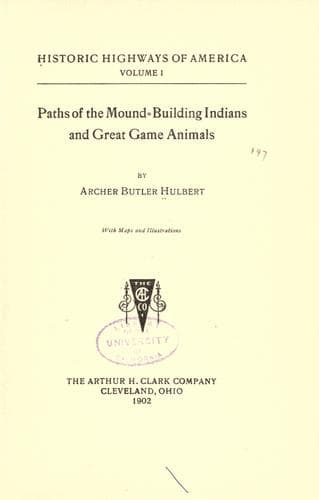
Paths of the Mound-Building Indians and Great Game AnimalsHulbert, Archer Butler
History
Paths of the Mound-Building Indians and Great Game Animals
Hulbert, Archer Butler
American bison; Indian trails -- United States; Mound-builders
"Exploring the country from the headwaters of Cumberland river to the
Ohio, they discovered its main streams, and its variety of soil and
surface. By following its trodden roads, or 'traces' as the pioneers
called them, which the buffaloes made from their grazing fields and
brakes, they [Boone and his brother] found a number of the great 'licks'
to which wild animals in countless multitudes commonly resorted in hunt
of salt. These buffalo traces are plainly marked out to the present
day."[108]
One or two references will show how common it was to refer to buffalo
"traces" as the main thoroughfares of Kentucky: "Hardly had the plaudits
of the pioneers for the women of Bryant's Station died on the stillness
of the sultry August air ere summer breezes carried the story of the
awful carnage and destruction at the Battle of the Blue Licks, from the
valley of the Licking, by the buffalo traces, to the settlements on the
Kentucky River."[109] "... It was the 16th of August when Caldwell and
McKee, piloted by Simon Girty, assailed the place [Bryant's Station].
They had surrounded it during the previous night. They came like the
pestilence that walks in darkness, unexpected and unseen. They had
marched along the buffalo traces or stolen through the forests without
having given to any one any notice of their intention."[110]
The course of one of these famous "traces" is thus described:
"From Big Bone Lick buffalo roads led to Blue Licks, and also southwest
to Drennon's Lick, in Henry County, thence to the crossing of the
Kentucky just below Frankfort. From the valley of the river they then
passed to the high ground east of Frankfort by a deeply worn road yet
visible, known as the Buffalo Trace, to the Stamping Ground, in Scott
County, a town named from the fact that the animals in vast herds would
tread or stamp the earth while crowded together and moving around in the
effort of those on the outside to get inside and thus secure protection
from the flies. Thence they passed by the Great Crossings, so called
from its being the place where they crossed Elkhorn, two miles west of
Georgetown, and thence eastward to Blue Lick, May's Lick, and across the
river into Ohio. Their roads formed in the comparatively level country
the routes of the immigrants through the dense forests, impenetrable
from the heavy cane, peavines, and other undergrowth. They also
determined in many portions of the State not only the lines of travel
and transportation, but also of settlement, as particularly shown
between Maysville and Frankfort, a distance of about eighty miles, where
the settlements were first made along the Buffalo road, and later the
turnpike and railroad followed in close proximity to the route surveyed
by this sagacious animal, which Mr. Benton said blazed the way for the
railroad to the Pacific. The same idea is embodied in the vernacular of
the unlettered Kentuckian who said that the then great roadmakers were
'the buffler, the Ingin, and the Ingineer.'"[111]
Public-domain text, read in full here on John Shaqi.
Reviews
Reviews
No reviews yet
Be the first to share your thoughts on this work.
Join the Discussion
Join the discussion
Sign in to leave a comment or review.
Sign InorCreate an account