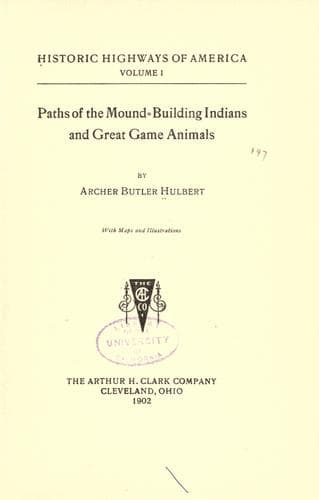
Paths of the Mound-Building Indians and Great Game AnimalsHulbert, Archer Butler
History
Paths of the Mound-Building Indians and Great Game Animals
Hulbert, Archer Butler
American bison; Indian trails -- United States; Mound-builders
Other strategic lines of travel perhaps first opened by the buffalo were
the portage paths between the heads of streams, especially those of the
Ohio basin and the lake streams on the north and the Atlantic streams
on the south. Undoubtedly in his migrations north and south the buffalo
deeply wore the river trails, for here he was close to water and the
river meadows which constantly offered all the nourishment he needed. At
least, when white men first came into the West they found great paths
over the portages which were more of the nature of buffalo roads than
Indian trails. Certain of these portages have been noted; others were
between the French Creek and Lake Erie--a portage undoubtedly well known
to the buffalo--which the French named Rivière aux Boeufs in honor of
these monarchs of the forests; others again between the Cuyahoga and the
Muskingum, the Scioto and Sandusky, the Wabash and Maumee, St. Joseph
and Kankakee, Fox and Illinois, etc. The prehistoric use of portages has
elsewhere been noticed in connection with the mound-building Indians.
They were perhaps the earliest of traveled ways of the continent.
FOOTNOTES:
[1] _Twelfth Annual Report of the Bureau of Ethnology_, p. 601.
[2] _Id._, p. 17, art. 7.
[3] _Id._, p. 645.
[4] _Report of the Geological Survey of Ohio_, vol. vii., part ii., p.
37.
[5] _Bulletin_, 1891.
[6] _Twelfth Annual Report of the Bureau of Ethnology_, p. 525.
[7] _Life and Times of Ephraim Cutler_, p. 23.
[8] General Butler's _Journal_, "The Olden Time," vol. ii., pp. 455-456.
[9] Cf. Gist's, Dr. Walker's, Boone's, Washington's, Post's,
Zeisberger's, Croghan's, Heckewelder's, journeys into the West as
related in their _Journals_ or letters; note the routes of such armies
as those led by Bouquet and McIntosh which went from Fort Pitt to the
interior of Ohio, or by Lewis which marched from Virginia to the mouth
of the Great Kanawha, or by Harmar, St. Clair, and Wayne, which went
northward from the Ohio river toward the Great Lakes. Troops were
shipped frequently from Pittsburg and Detroit westward by water, but is
there one instance where they were transported into the interior on the
smaller rivers? Cf. Pentland's _Journal_, "History of Western
Pennsylvania," appendix, pp. 389-391.
[10] _Life and Times of Ephraim Cutler_, p. 21.
[11] Hildreth's _Pioneer History_, p. 159.
[12] Gen. Moses Cleaveland, on coming to the site of the city which
bears his name, found he could not ascend the Cuyahoga because of the
vast quantity of deadwood which filled it.
[13] MacLean's _Mound Builders_, p. 145.
[14] _Twelfth Annual Report of the Bureau of Ethnology_, p. 52.
[15] _Id._, pp. 54-55.
[16] _Id._, p. 54.
[17] _Id._, p. 56.
[18] _Id._, p. 58.
[19] _Id._, p. 58.
[20] _Id._, p. 59.
[21] _Id._, p. 60.
[22] _Id._, p. 62.
[23] _Id._, p. 184.
[24] _Id._, p. 192.
[25] _Id._, pp. 198-215.
[26] _Id._, p. 449.
[27] _Id._, p. 451.
[28] _Id._, p. 452.
[29] _Id._, p. 458.
[30] _Id._, p. 458.
Public-domain text, read in full here on John Shaqi.
Reviews
Reviews
No reviews yet
Be the first to share your thoughts on this work.
Join the Discussion
Join the discussion
Sign in to leave a comment or review.
Sign InorCreate an account