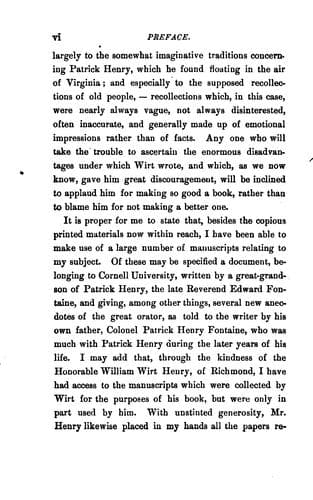
This anecdote, implying Patrick Henry's ability to express himself
in Latin, I give for what it may be worth. Some will think it
incredible, and that impression will be further increased by the
fact that Colonel Fontaine names Albert Gallatin as the visitor
with whom, on account of his ignorance of English, the conversation
was thus carried on in Latin. This, of course, must be a mistake;
for, at the time of his first visit to Virginia, Gallatin could
speak English very well, so well, in fact, that he went to Virginia
expressly as English interpreter to a French gentleman who could not
speak our language.[15] However, as, during all that period,
Governor Henry had many foreign visitors, Colonel Fontaine, in his
subsequent account of that particular visitor, might easily have
misplaced the name without thereby discrediting the substance of his
narrative. Indeed, the substance of his narrative, namely, that he,
Colonel Fontaine, did actually witness, in the case of some foreign
visitor, such an exhibition of his grandfather's good early training
in Latin, cannot be rejected without an impeachment of the veracity
of the narrator, or at least of that of his son, who has recorded
the alleged incident. Of course, if that narrative be accepted as
substantially true, it will be necessary to conclude that the
Jeffersonian tradition of Patrick Henry's illiteracy is, at any
rate, far too highly tinted.
Thus far we have been dealing with the question of Patrick Henry's
education down to the time of his leaving school, at the age of
fifteen. It was not until nine years afterward that he began the study
of the law. What is the intellectual record of these nine years? It is
obvious that they were years unfavorable to systematic training of
any sort, or to any regulated acquisition of knowledge. During all
that time in his life, as we now look back upon it, he has for us the
aspect of some lawless, unkempt genius, in untoward circumstances,
groping in the dark, not without wild joy, towards his inconceivable,
true vocation; set to tasks for which he was grotesquely unfit;
blundering on from misfortune to misfortune, with an overflow of
unemployed energy and vivacity that swept him often into rough fun,
into great gusts of innocent riot and horseplay; withal borne along,
for many days together, by the mysterious undercurrents of his nature,
into that realm of reverie where the soul feeds on immortal fruit and
communes with unseen associates, the body meanwhile being left to the
semblance of idleness; of all which the man himself might have given
this valid justification:--
"I loafe and invite my soul,
I lean and loafe at my ease, observing a spear of summer grass."
Public-domain text, read in full here on John Shaqi.
Reviews
Reviews
No reviews yet
Be the first to share your thoughts on this work.
Join the Discussion
Join the discussion
Sign in to leave a comment or review.
Sign InorCreate an account