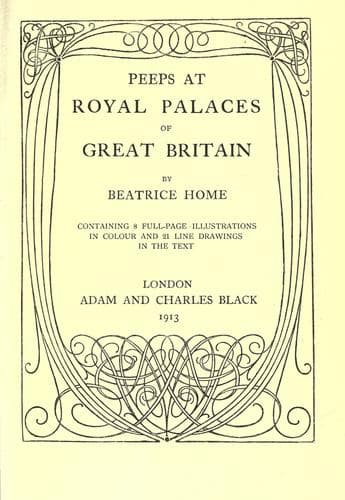
Peeps at Royal Palaces of Great BritainHome, Beatrice
History
Peeps at Royal Palaces of Great Britain
Home, Beatrice
Palaces -- Great Britain
When James I. succeeded to the throne of the Tudors, he found the
palace of Whitehall needing a considerable amount of repairs. The
old banqueting hall that had sufficed for the needs of Elizabeth
was despised by the new monarch, who regarded it as an "old rotten
slight-builded Banqueting House." Inigo Jones, the great architect,
was called upon to supply plans for an entirely new palace. His plans,
the originals of which still exist, were extremely ambitious, for
if they had been carried out, London would have possessed a palace
rivalling Versailles, and covering an area of twenty four acres.
According to his scheme, the palace was to present four imposing
frontages, having square towers at the corners, and was to contain one
vast central court, as well as six smaller courts. Only the stately
banqueting hall of this colossal scheme was ever erected, that which
remains to-day, the solitary fragment of the once extensive palace.
The hall was finished in 1622, and when, three years later, Charles I.
came to the throne, he was too much overwhelmed with the difficulty of
obtaining sufficient money to supply his immediate needs, to entertain
any ideas of carrying out the proposed palace. He contented himself
with adorning the existing banqueting hall, commissioning the artist
Rubens, who was in London in the capacity of Ambassador from Flanders,
to paint the ceiling. For the magnificent work which we see to-day,
covering the entire ceiling, representing the apotheosis of James I.
the artist received £3,000 and a knighthood from King Charles.
It was outside the banqueting hall which he had so enriched, that King
Charles was beheaded on January 30, 1649. Early on the cold wintry
morning, escorted by a body of soldiers, Charles walked from St.
James's Palace, where he had spent his last night, across the park
to Whitehall. Owing to the cold he had put on two shirts, in order to
prevent any shivering, which might, the King thought, have been put
down to fear. Wearing a black cloak, and a striped red silk waistcoat,
he walked rapidly, telling Bishop Juxon, who accompanied him, that he
was soon going to obtain a heavenly crown. On the way he pointed out
a tree in Spring Gardens, planted by his elder brother, Henry. Arrived
at Whitehall, he crossed over the gallery above the Holbein Gate,
and went to his own room in the palace, awaiting the order for his
appearance on the scaffold, spending the time in prayer.
Public-domain text, read in full here on John Shaqi.
Reviews
Reviews
No reviews yet
Be the first to share your thoughts on this work.
Join the Discussion
Join the discussion
Sign in to leave a comment or review.
Sign InorCreate an account