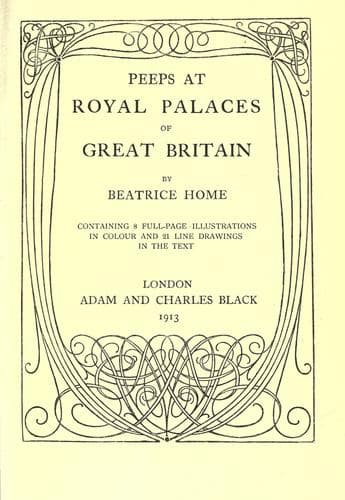
Peeps at Royal Palaces of Great BritainHome, Beatrice
History
Peeps at Royal Palaces of Great Britain
Home, Beatrice
Palaces -- Great Britain
Though Charles I. grew to be devotedly attached to his French bride,
Henrietta Maria, he had some unfortunate disagreements with her during
the early months of his married life, which he spent at Hampton Court.
Owing partly to the interference of the Duke of Buckingham, Charles's
unwise favourite, and to the young bride's extreme youth and lack of
tact, there were constant quarrels between the royal pair. Henrietta
Maria's large train of French followers were extremely unpopular among
the English, owing to their religious beliefs, and the Queen herself
was ill-advised enough to refuse to take part in the coronation
ceremonies, as they were performed by Protestant clergy. At last
Charles grew so annoyed that he dismissed all the French suite in a
high-handed manner, and sent them back to France. Though the Queen
never became popular among the Puritans, who attributed much of the
King's stubbornness to her suggestion, yet she and her royal husband
learned to live together in great domestic bliss.
The first hint of the gathering storm was made evident to the King
when the Commons brought down to the palace their Grand Remonstrance,
a document in which they had recorded, in unqualified language,
all the King's misdeeds. Charles retaliated by the fatal error of
attempting to arrest five members of the Commons; after the failure of
which he retired from London to Hampton Court--the last time (except
for one night) that he visited it as a free man. In the summer of
1647, when his armies had all been crushed and dispersed, he came
to the palace once more, but this time as a prisoner. He was still
treated with great respect and allowed considerable liberty, visiting
his children at Sion House, and having them visit him. Unhappily
Charles determined to escape, and was so far successful that he
succeeded in slipping from the palace, crossing the river, and
reaching the Isle of Wight. But there his success ended, for he
was obliged to give himself up as a prisoner to the governor of the
island, to be treated afterwards with increasing severity.
Cromwell's soldiers are credited with effecting considerable damage
to historic buildings, but we are indebted to the Protector for the
saving of Hampton Court Palace. It had already been sold to various
purchasers, when Cromwell became Lord Protector and the Parliament,
knowing his liking for the palace, at once set to work to repurchase
it. The Protector and his family soon after took up their residence
there, provoking the mocking laughter of royalists, either for the
regal state which Cromwell maintained, or the homeliness of his
wife. It is strange to remember, that along with all his austerity of
character Cromwell used to indulge, in his lighter moments, in great
buffoonery, putting sticky sweetmeats on to the chairs on which
the ladies were to sit, slipping live coals into his officers' coat
pockets, or throwing wine about.
Public-domain text, read in full here on John Shaqi.
Reviews
Reviews
No reviews yet
Be the first to share your thoughts on this work.
Join the Discussion
Join the discussion
Sign in to leave a comment or review.
Sign InorCreate an account