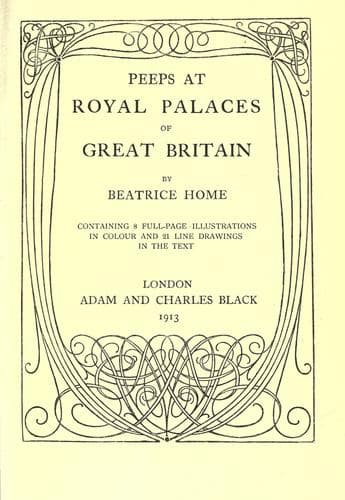
Peeps at Royal Palaces of Great BritainHome, Beatrice
History
Peeps at Royal Palaces of Great Britain
Home, Beatrice
Palaces -- Great Britain
When William III., "a great man in a little crazy body" as Leigh
Hunt calls him, found that he could not stand the smoky atmosphere of
Whitehall, he looked about for a place sufficiently near London for
him to be near his Ministers, and yet should be rural enough to have
clear fresh air. He found this spot in the village of Kensington,
where he bought a suburban mansion, formerly the residence of the
Earls of Nottingham. Here he at once began building, and laying out
gardens in the formal Dutch fashion, employing Sir Christopher Wren
to make the alterations to the house. While the King was in
Ireland fighting against his father-in-law, James II., Queen Mary
superintended the work, writing to her absent husband of the slow
progress the builders were making, and how "the place made me think
how happy I was there when I had your dear company." A road was
specially constructed through Hyde Park, gravelled and lighted with
lamps, for the convenience of the officers of State, who were obliged
to visit the monarch in his country retreat.
Queen Mary did not long enjoy the pleasures of Kensington Palace, for
in the winter of 1694, an epidemic of smallpox, which was raging in
the neighbourhood, crept through the palace gates, and attacked the
young Queen. Immediately she knew the terrible nature of her fate, the
Queen, with her usual kind consideration, directed that all her ladies
and servants who had not had smallpox should hurry from the palace,
while she herself, having put everything in order, calmly prepared for
death. King William could scarcely be persuaded to leave his beloved
wife, even to lie down at night upon the camp bed arranged for him
in the ante-chamber. Tears ran down the stern face which was seldom
allowed to betray any emotion, and in the end, just before Queen Mary
died, he was carried away from her bedside fainting. As he said to
Bishop Burnet, "I was the happiest man on earth; and I am the most
miserable. She had no fault; none: you knew her well: but you could
not know, nobody but myself could know her goodness."
Public-domain text, read in full here on John Shaqi.
Reviews
Reviews
No reviews yet
Be the first to share your thoughts on this work.
Join the Discussion
Join the discussion
Sign in to leave a comment or review.
Sign InorCreate an account