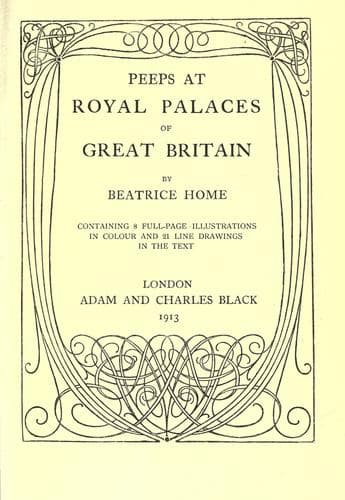
Peeps at Royal Palaces of Great BritainHome, Beatrice
History
Peeps at Royal Palaces of Great Britain
Home, Beatrice
Palaces -- Great Britain
The public will not soon forget the momentous events associated with
the palace during the last reign; the serious illness of King Edward,
on the eve of his Coronation, postponing the great ceremony for which
many distinguished visitors had already arrived, and then after a
short but brilliant reign, the sudden death of the popular monarch,
throwing all the country into mourning. Almost before anyone knew
that the King was seriously ill, for he had only just come back from
Biarritz, the bulletin, announcing that "His Majesty breathed his
last" within the palace, was read by the sorrowing crowds.
CHAPTER XIII
VANISHED PALACES
Besides the palaces whose stories have been related, there were at one
time many other royal residences scattered over England. These have
either entirely vanished, even their sites being problematical, or
mere fragments of them alone remain. While England remained in an
unsettled condition, with constant internal wars, the Kings were
always moving about taking their Court with them, staying in their
various castles or fortified houses. We find that Henry II., the first
of the Plantagenet Kings, never stayed long in any place, generally
moving on after a few days' visit. But when more settled times came,
and the Parliament remained at Westminster, the King came to live
longer in London or at one of his royal houses in the neighbourhood.
Some of the country palaces were maintained on account of the hunting
they afforded.
A few brief notes must suffice for these vanished palaces.
=Baynards Castle= was situated on the River Thames not far from
St. Paul's. In 1461 the City of London tendered their allegiance to
Edward, Duke of York (Edward IV.) at Baynards Castle, and by doing
so secured his triumph. It became a royal house on the attainder of
Humphrey, Duke of Gloucester, and was rebuilt by Henry VIII., but was
seldom occupied by the sovereign. Queen Mary gave it to the Earl of
Pembroke.
[Illustration: Baynards Castle in 1790.]
=Dartford Priory= was turned into a house for the King after the
dissolution of the monasteries. It is chiefly associated with King
Henry VIII.'s fourth wife, Anne of Cleves, who lived there during
the reign of Edward VI. and until her death in 1556. Queen Elizabeth
occasionally visited it, but when it was found to need costly repairs
James I. granted it to Robert, Earl of Salisbury.
=Enfield Palace=, though a Crown property from the time of Henry IV.,
was not used as a royal residence until the time of Henry VIII. Queen
Elizabeth was at Enfield when Henry VIII. died, and she often visited
it after she came to the Throne. It was sold to the Earl of Pembroke
in 1641.
=Hatfield House= was acquired by Henry VIII., whose daughter, Queen
Elizabeth, lived there during her sister's reign. James I. persuaded
Sir Robert Cecil to accept it in exchange for his house at Theobalds.
Public-domain text, read in full here on John Shaqi.
Reviews
Reviews
No reviews yet
Be the first to share your thoughts on this work.
Join the Discussion
Join the discussion
Sign in to leave a comment or review.
Sign InorCreate an account