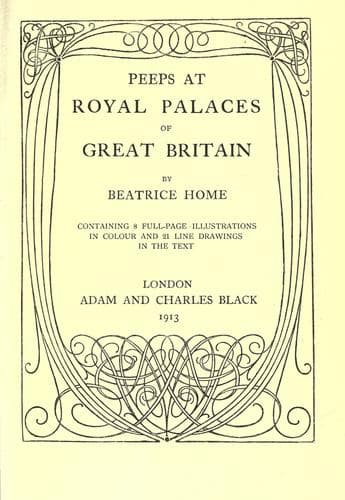
Peeps at Royal Palaces of Great BritainHome, Beatrice
History
Peeps at Royal Palaces of Great Britain
Home, Beatrice
Palaces -- Great Britain
=Theobalds=, on the borders of Hertfordshire, was built by Robert
Cecil, Lord Burleigh, who often entertained Queen Elizabeth, an honour
which cost him £2,000 a visit. James I. was so delighted with it when
he came there on his royal progress from Scotland, that he induced his
host to let him have it in exchange for Hatfield. He was frequently
there, enjoying the hunting in the neighbourhood, and died there in
1625, his son Charles being proclaimed at the gate. At the Civil
War it was much damaged, afterwards being parcelled out among some
Parliamentarian officers. The last remains disappeared in 1766.
=Winchester Castle= was built, according to tradition, by Arthur, and
was constantly used by the early English Kings. It was the birthplace
of Henry III., and Parliament assembled there occasionally until the
fifteenth century. Henry V. was the last King to reside there. In the
time of the Commonwealth it came into the possession of Sir William
Waller, from whom the Corporation bought it.
=Woodstock=, in Oxfordshire, was a royal manor when the Domesday
survey was made. It was at Woodstock that Queen Eleanor, the wife of
Henry II., discovered the Fair Rosamond, daughter of Lord Clifford,
who was so much loved by her royal master. Much of the story is
probably legend; she was certainly not murdered by the jealous Queen,
but died in Godstow nunnery. Edward III. and Queen Philippa were much
attached to the palace, where their eldest son, the Black Prince, was
born. After Wyatt's rebellion, Queen Elizabeth was guarded there as a
prisoner. James I. liked it for the hunting it afforded, and Charles
I. was often there during his reign, especially when his army was at
Oxford during the Civil War. It fell into ruin after the war, and the
estate was given to the Duke of Marlborough after his famous victory
at Blenheim. The architect of Blenheim Palace wished to save the ruins
which still remained, but the Duchess of Marlborough declared that
they spoilt the view, and so swept them away completely in 1723.
[Illustration: EDINBURGH CASTLE
Stands upon a great rock rising abruptly from low-lying ground. Its
history stretches back to the dim time of legends.]
CHAPTER XIV
EDINBURGH CASTLE
Edinburgh Castle has a history that stretches far back till it is lost
in the misty realm of legend. The great rock upon which it is built
could not fail to have appealed to all the successive rulers of the
land as of great strategic importance. It rises abruptly from the
low-lying land, and dominates the country for many miles around, from
the Forth on the north to the Pentland Hills on the south. Its Celtic
name of _Maidun_, meaning the fort of the plain, became corrupted in
later times to Maiden's Castle, the name being responsible for the
tradition that the castle was used by the royal Princesses, during
times of great danger.
[Illustration: Edinburgh Castle, from the North.]
Public-domain text, read in full here on John Shaqi.
Reviews
Reviews
No reviews yet
Be the first to share your thoughts on this work.
Join the Discussion
Join the discussion
Sign in to leave a comment or review.
Sign InorCreate an account