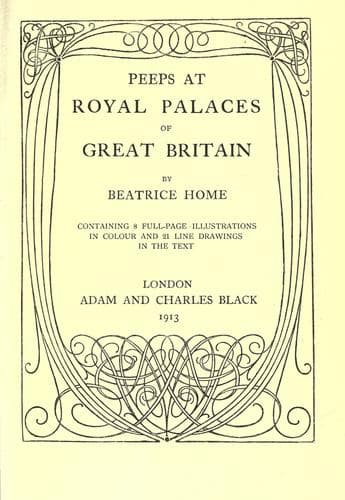
Peeps at Royal Palaces of Great BritainHome, Beatrice
History
Peeps at Royal Palaces of Great Britain
Home, Beatrice
Palaces -- Great Britain
During the Civil War the castle was held by the Parliamentary forces,
whose mere presence behind the strong walls was sufficient to repel
Prince Rupert, Charles I.'s headstrong nephew, who had hoped with a
small body of horse to surprise the castle. No further attempt was
made by the Royalists to capture the royal fortress, to which King
Charles was brought as a prisoner in December, 1648. For three years
the unhappy King had been a captive, driven from prison to prison,
Windsor being his last resting-place before his trial and death in
London. Charles must have become aware that dangers were thickening
round him, when, having refused to admit Denbigh bearing the last
overtures of the Army, all ceremonies of State were omitted, his meals
no longer being served to him on bended knee. After the tragedy at
Whitehall, the body of the King was brought to Windsor and buried
hurriedly one snowy February morning, in the vault below the choir,
by the side of Henry VIII. At the Restoration £70,000 was voted by
the Parliament to erect a fitting memorial, but for some unexplained
reason his coffin could not be found, though two of the Lords who had
carried his body to the grave were still living. Though the leaden
coffin was identified in 1813, no monument has yet been raised to the
most unfortunate if also the most unwise of British sovereigns.
His son, Charles II., employed Sir Christopher Wren to make additions
to the palace. Much of this work still remains practically as it was
in the days of the Merry Monarch, for whose dining-room (now called
the State Ante-room) Verrio painted the ceiling and Grinling Gibbons
carved the walls.
Public-domain text, read in full here on John Shaqi.
Reviews
Reviews
No reviews yet
Be the first to share your thoughts on this work.
Join the Discussion
Join the discussion
Sign in to leave a comment or review.
Sign InorCreate an account