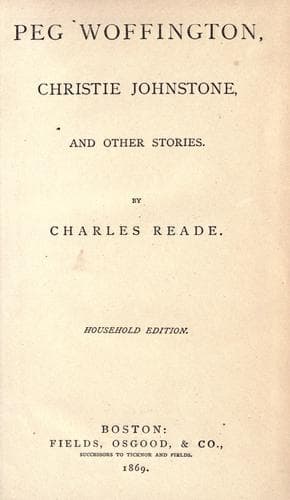
Actresses -- Fiction; Biographical fiction; Great Britain -- History -- 18th century -- Fiction; Woffington, Margaret, -1760 -- Fiction
“No, no!” cried Triplet, with tears in his eyes. “It is I who have been
rough and brutal. Poverty tried us too hard; but we were not like the
rest of them--we were always faithful to the altar. And the Almighty has
seen us, though we often doubted it.”
“I never doubted that, James.”
So then the poor things fell on their knees upon the public road, and
thanked God. If any man had seen them, he would have said they were mad.
Yet madder things are done every day by gentlemen with faces as grave as
the parish bull's. And then they rose and formed their little plans.
Triplet was for devoting four-fifths to charity, and living like a
prince on the remainder. But Mrs. Triplet thought the poor were entitled
to no more than two-thirds, and they themselves ought to bask in a
third, to make up for what they had gone through; and then suddenly she
sighed, and burst into tears. “Lucy! Lucy!” sobbed she.
Yes, reader, God had taken little Lucy! And her mother cried to think
all this wealth and comfort had come too late for her darling child.
“Do not cry. Lucy is richer, a thousand times, than you are, with your
twenty thousand pounds.”
Their good resolutions were carried out, for a wonder. Triplet lived
for years, the benefactor of all the loose fish that swim in and round
theaters; and, indeed, the unfortunate seldom appealed to him in vain.
He now predominated over the arts, instead of climbing them. In his
latter day he became an oracle, as far as the science of acting was
concerned; and, what is far more rare, he really got to know _something_
about it. This was owing to two circumstances: first, he ceased to run
blindfold in a groove behind the scenes; second, he became a frequenter
of the first row of the pit, and that is where the whole critic, and
two-thirds of the true actor, is made.
On one point, to his dying day, his feelings guided his judgment. He
never could see an actress equal to his Woffington. Mrs. Abington
was grace personified, but so was Woffington, said the old man: and
Abington's voice is thin, Woffington's was sweet and mellow. When Jordan
rose, with her voice of honey, her dewy freshness, and her heavenly
laugh, that melted in along with her words, like the gold in the quartz,
Triplet was obliged to own her the goddess of beautiful gayety; but
still he had the last word: “Woffington was all _she_ is, except her
figure. Woffington was a Hebe; your Nell Jordan is little better than a
dowdy.”
Public-domain text, read in full here on John Shaqi.
Reviews
Reviews
No reviews yet
Be the first to share your thoughts on this work.
Elsewhere in the archive
Join the Discussion
Join the discussion
Sign in to leave a comment or review.
Sign InorCreate an account