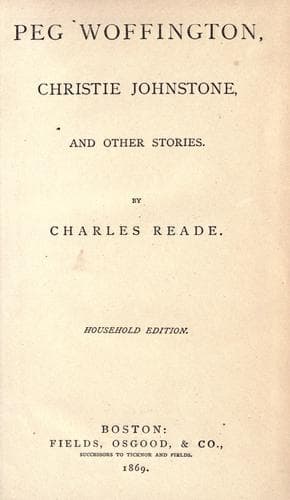
Actresses -- Fiction; Biographical fiction; Great Britain -- History -- 18th century -- Fiction; Woffington, Margaret, -1760 -- Fiction
“Then I will own to you--”
“Oh, do not tell me you have ever loved before me! I could not bear to
hear it!” cried this inconsistent personage.
The other weak creature needed no more.
“I see plainly I never loved but you,” said he.
“Let me hear that only!” cried she; “I am jealous even of the past. Say
you never loved but me. Never mind whether it is true. My child, you do
not even yet know love. Ernest, shall I make you love--as none of your
sex ever loved--with heart, and brain, and breath, and life, and soul?”
With these rapturous words, she poured the soul of love into his eyes;
he forgot everything in the world but her; he dissolved in present
happiness and vowed himself hers forever. And she, for her part, bade
him but retain her esteem and no woman ever went further in love than
she would. She was a true epicure. She had learned that passion, vulgar
in itself, is god-like when based upon esteem.
This tender scene was interrupted by the call-boy, who brought Mrs.
Woffington a note from the manager, informing her there would be
no rehearsal. This left her at liberty, and she proceeded to take a
somewhat abrupt leave of Mr. Vane. He was endeavoring to persuade her
to let him be her companion until dinner-time (she was to be his quest),
when Pomander entered the room.
Mrs. Woffington, however, was not to be persuaded, she excused herself
on the score of a duty which she said she had to perform, and whispering
as she passed Pomander, “Keep your own counsel,” she went out rather
precipitately.
Vane looked slightly disappointed.
Sir Charles, who had returned to see whether (as he fully expected) she
had told Vane everything--and who, at that moment, perhaps, would
not have been sorry had Mrs. Woffington's lover called him to serious
account--finding it was not her intention to make mischief, and not
choosing to publish his own defeat, dropped quietly into his old line,
and determined to keep the lovers in sight, and play for revenge.
He smiled and said: “My good sir, nobody can hope to monopolize Mrs.
Woffington. She has others to do justice to besides you.”
To his surprise, Mr. Vane turned instantly round upon him, and, looking
him haughtily in the face, said: “Sir Charles Pomander, the settled
malignity with which you pursue that lady is unmanly and offensive to
me, who love her. Let our acquaintance cease here, if you please, or let
her be sacred from your venomous tongue.”
Sir Charles bowed stiffly, and replied, that it was only due to himself
to withdraw a protection so little appreciated.
The two friends were in the very act of separating forever, when who
should run in but Pompey, the renegade. He darted up to Sir Charles, and
said: “Massa Pomannah she in a coach, going to 10, Hercules Buildings.
I'm in a hurry, Massa Pomannah.”
“Where?” cried Pomander. “Say that again.”
“10, Hercules Buildings, Lambeth. Me in a hurry, Massa Pomannah.”
“Faithful child, there's a guinea for thee. Fly!”
Public-domain text, read in full here on John Shaqi.
Reviews
Reviews
No reviews yet
Be the first to share your thoughts on this work.
Join the Discussion
Join the discussion
Sign in to leave a comment or review.
Sign InorCreate an account