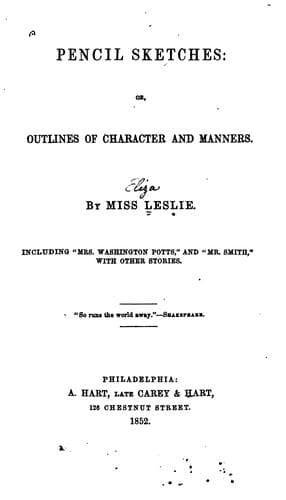
Pencil Sketches; or, Outlines of Character and MannersLeslie, Eliza
General
Pencil Sketches; or, Outlines of Character and Manners
Leslie, Eliza
Humorous stories; Short stories, American; United States -- Social life and customs -- 19th century -- Fiction
The hand of Miss Mandeville had been sought openly by one-half the
gentlemen that boasted the honour of her acquaintance, and it had been
hinted at by the other half, with the exception of Gordon Fitzsimmons, a
young attorney of highly promising talents, whose ambition would have
led him to look forward to the probability of arriving at the summit of
his profession, but whose rise was, as yet, somewhat impeded by several
very singular notions: such, for instance, as that a lawyer should never
plead against his conscience, and never undertake what he knows to be
the wrong side of a cause.
Another of his peculiarities was a strange idea that no gentleman should
ever condescend to be under pecuniary obligations to his
wife--ergo--that a man who has nothing himself, should never marry a
woman that has anything. This last consideration had induced Mr.
Fitzsimmons to undertake the Herculean task of steeling his heart, and
setting his face against the attractions of Miss Mandeville, with all
her advantages of mind and person. Notwithstanding, therefore, that her
conversation was always delightful to him, he rarely visited her, except
when invited with other company.
Lucinda Mandeville, who, since the age of sixteen, had been surrounded
by admirers, and accustomed to all the adulation that is generally
lavished on a beauty and an heiress, was surprised at the apparent
coldness of Gordon Fitzsimmons, than whom she had never met with a young
man more congenial to her taste. His manifest indifference continually
attracted her attention, and, after awhile, she began to suspect that it
was no indifference at all, and that something else lurked beneath it.
What that was, the sagacity of her sex soon enabled her to discover.
Fitzsimmons never urged Lucinda to play, never handed her to the piano,
never placed her harp for her, never turned over the leaves of her music
book; but she always perceived that though he affected to mingle with
the groups that stood round as listeners, he uniformly took a position
from whence he could see her to advantage all the time. When she
happened to glance towards him, which, it must be confessed, she did
much oftener than she intended (particularly when she came to the finest
passage of her song), she never failed to find his eyes fixed on her
face with a gaze of involuntary admiration, that, when they met, was
instantly changed to an averted look of indifference.
Though he was scrupulous in dancing with her once only in the course of
the evening, she could not but perceive that, during this set, his
countenance, in spite of himself, lighted up with even more than its
usual animation. And if she accidentally turned her head, she saw that
his eyes were following her every motion: as well indeed they might, for
she danced with the lightness of a sylph, and the elegance of a lady.
Public-domain text, read in full here on John Shaqi.
Reviews
Reviews
No reviews yet
Be the first to share your thoughts on this work.
Elsewhere in the archive
Join the Discussion
Join the discussion
Sign in to leave a comment or review.
Sign InorCreate an account