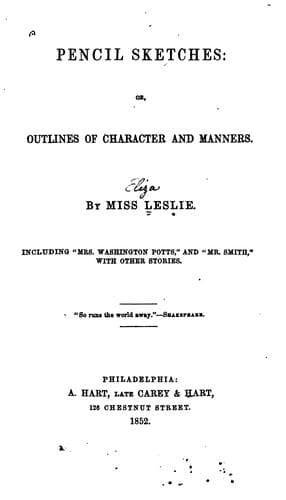
Pencil Sketches; or, Outlines of Character and MannersLeslie, Eliza
General
Pencil Sketches; or, Outlines of Character and Manners
Leslie, Eliza
Humorous stories; Short stories, American; United States -- Social life and customs -- 19th century -- Fiction
Notwithstanding his own acknowledged taste for everything connected with
the fine arts, Fitzsimmons never asked to see Miss Mandeville's
drawings. But she observed that after she had been showing them to
others, and he supposed her attention to be elsewhere engaged, he failed
not to take them up, and gaze on them as if he found it difficult to lay
them down again.
In conversation, he never risked a compliment to Miss Mandeville, but
often dissented with her opinion, and frequently rallied her.--Yet when
she was talking to any one else, he always contrived to be within
hearing; and frequently, when engaged himself in conversing with others,
he involuntarily stopped short to listen to what Lucinda was saying.
Miss Mandeville had read much, and seen much, and had had much love
made to her: but her heart had never, till now, been touched even
slightly. That Fitzsimmons admired her, she could not possibly doubt:
and that he loved her, she would have been equally certain, only that he
continued all the time in excellent health and spirits; that, so far
from sitting "like patience on a monument," he seldom sat anywhere; that
when he smiled (which he did very often) it was evidently not at grief;
and that the concealment he affected, was assuredly not feeding on his
cheek, which, so far from turning "green and yellow," had lost nothing
of its "natural ruby."
Neither was our heroine at all likely to die for love. Though there
seemed no prospect of his coming to a proposal, and though she was
sometimes assured by the youngest and prettiest of her female friends,
that they knew from authentic sources that Mr. Fitzsimmons had
magnanimously declared against marrying a woman of fortune; yet other
ladies, who were neither young nor handsome, and had no hope of Mr.
Fitzsimmons for themselves, were so kind as to convince Miss Mandeville
that he admired her even at "the very top of admiration." And these
generous and disinterested ladies were usually, after such agreeable
communications, invited by Miss Mandeville to pass the evening with her.
Also--our heroine chanced one day to overhear a conversation between
Dora, her own maid, and another mulatto girl; in which Dora averred to
her companion that she had heard from no less authority than Squire
Fitzsimmons's man Cato, "who always wore a blue coat, be the colour what
it may, that the squire was dead in love with Miss Lucinda, as might be
seen from many invisible _symptoms_, and that both Dora and Cato had a
certain _foregiving_ that it would turn out a match at last, for all
that the lady had the money on her side, which, to be sure, was rather
unnatural; and that the wedding might be looked for _momently_, any
minute."
Public-domain text, read in full here on John Shaqi.
Reviews
Reviews
No reviews yet
Be the first to share your thoughts on this work.
Elsewhere in the archive
Join the Discussion
Join the discussion
Sign in to leave a comment or review.
Sign InorCreate an account