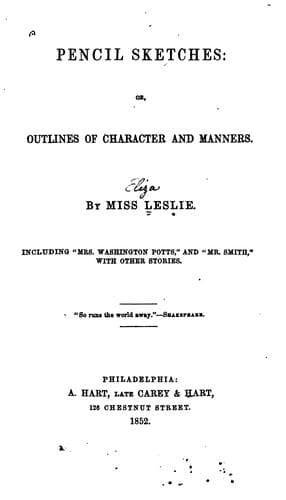
Pencil Sketches; or, Outlines of Character and MannersLeslie, Eliza
General
Pencil Sketches; or, Outlines of Character and Manners
Leslie, Eliza
Humorous stories; Short stories, American; United States -- Social life and customs -- 19th century -- Fiction
In the course of the next quarter of an hour, Miss Lucinda called Dora
into her dressing-room, and presented her with a little Thibet shawl,
which she had worn but once. Dora grinned understandingly: and from that
time she contrived to be overheard so frequently in similar
conversations, that much of the effect was diminished.
To resume the thread of our narrative--Lucinda being one morning on a
visit to her friend Miss Delwin, the latter adverted to the failure of
the annual dancing party.
"What would the beaux say," exclaimed Lucinda, struck with a sudden
idea, "if the belles were to give a ball to _them_, by way of hinting
our sense of their extraordinary remissness? Let us convince them that,
according to the luminous and incontrovertible aphorism of the renowned
Sam Patch, 'some things may be done as well as others.'"
"Excellent," replied Miss Delwin; "the thought is well worth pursuing.
Let us try what we can make of it."
The two young ladies then proceeded to an animated discussion of the
subject, and the more they talked of it, the better they liked it. They
very soon moulded the idea into regular form: and, as there was no time
to be lost, they set out to call on several of their friends, and
mention it to them.
The idea, novel as it seemed, was seized on with avidity by all to whom
it was suggested, and a secret conclave was held on the following
morning at Miss Mandeville's house, where the ladies debated with closed
doors, while the plan was organized and the particulars arranged: our
heroine proposing much that she thought would "point the moral and adorn
the tale."
Next day, notes of invitation to a ball given by the ladies, were sent
round to the gentlemen; all of whom were surprised, and many mortified,
for they at once saw the motive, and understood the implied reproof.
Some protested that they should never have courage to go, and talked of
declining the invitation. But the majority decided on accepting it,
justly concluding that it was best to carry the thing off with a good
grace; and having, besides, much curiosity to see how the ladies would
_conduct_, if we may be pardoned a Yankeeism.
Fitzsimmons declared that the delinquent beaux were rightly punished by
this palpable hit of the belles. And he congratulated himself on having
always voted in favour of the ball being given as formerly: secretly
hoping that Miss Mandeville knew that _he_ had not been one of the
backsliders. We are tolerably sure that she _did_ know it.
Eventually the invitations were all accepted, and the preparations went
secretly but rapidly on, under the superintendence of Miss Mandeville
and Miss Delwin. In the mean time, the gentlemen, knowing that they all
looked conscious and foolish, avoided the ladies, and kept themselves as
much out of their sight as possible; with the exception of Gordon
Fitzsimmons, he being the only one that felt freedom to "wear his beaver
up."
Public-domain text, read in full here on John Shaqi.
Reviews
Reviews
No reviews yet
Be the first to share your thoughts on this work.
Elsewhere in the archive
Join the Discussion
Join the discussion
Sign in to leave a comment or review.
Sign InorCreate an account