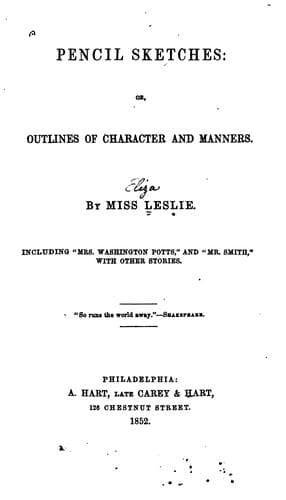
Pencil Sketches; or, Outlines of Character and MannersLeslie, Eliza
General
Pencil Sketches; or, Outlines of Character and Manners
Leslie, Eliza
Humorous stories; Short stories, American; United States -- Social life and customs -- 19th century -- Fiction
Mr. Culpepper gazed awhile at the miniature, and then turned over the
letters with a trembling hand. "I see," said he, "that there is no flaw
in the evidence. This is, indeed, a copy of my daughter's miniature.
These letters I have no desire to read, for, of course, they refer to
the plot that was in train for deceiving me. And they thought they had
well succeeded. But their punishment soon came, in a life of privation
and suffering, and in an early death to both. May such be the end of all
stolen marriages!--Still, she was my daughter; my only child.--So much
the worse; she should not have left me for a stranger."
It was painful and revolting to the kind-hearted Brighams to witness the
conflict between the vindictive spirit of this unamiable old man, and
the tardy rekindling of his parental feelings. In a few moments he made
an effort to speak with connexion and composure, and related the
following particulars. After the unsuccessful attack on Quebec, by the
gallant and ill-fated Montgomery, a young American officer, who had been
severely wounded in the conflict, was brought into the city, and
received the most kind and careful attendance from the family of a
gentleman who had once been intimately acquainted with his father. The
family who thus extended their hospitality to a suffering enemy, were
the next-door neighbours of Mr. Culpepper, whose name was then Osborne.
Captain Dalzel was a handsome and accomplished young man, and his case
excited much interest among the ladies of Quebec, and in none more than
in Miss Osborne, who, from her intimacy in the house at which he was
staying, had frequent opportunities of seeing him during his long
convalescence. A mutual attachment was the consequence, and it was kept
a profound secret from her father, who had in view for her a marriage
with a Canadian gentleman of wealth and consequence.
When Captain Dalzel was about to return home on being exchanged, he
prevailed on Miss Osborne to consent to a secret marriage. Mr. Culpepper
acknowledged that on discovering it he literally turned his daughter out
of doors, and sent back unopened a letter which she wrote to him from
Montreal. From that time he never suffered her name to be mentioned in
his presence; and he was almost tempted to consign to the flames a
miniature of her, that had been painted for him by an English artist,
then resident in Quebec. But a revulsion of feeling so far prevailed, as
to prevent him from thus destroying the resemblance of his only child;
and he put away the miniature with a firm resolution never to look at it
again. Five years afterwards he heard accidentally of Captain Dalzel's
having fallen in battle, and that Elizabeth had survived him but a few
days.
"And how did you feel when you heard this?" asked Colonel Brigham.
"Feel," replied Culpepper, fiercely; "I felt that she deserved her fate,
for having deceived her father, and taken a rebel for her husband, and
an enemy's country for her dwelling-place."
Public-domain text, read in full here on John Shaqi.
Reviews
Reviews
No reviews yet
Be the first to share your thoughts on this work.
Elsewhere in the archive
Join the Discussion
Join the discussion
Sign in to leave a comment or review.
Sign InorCreate an account